Vatican Museums
The Vatican Museums hold about 70,000 works collected by the popes since 1506, from the Laocoön and the Raphael Rooms to Michelangelo’s Sistine Chapel.
Vatican Museums: A Papal Art Collection Five Centuries in the Making
Walk through the Vatican Museums from the first courtyard to the last frescoed vault and you cover roughly two thousand years of Mediterranean art, plus a good chunk of Renaissance politics. The complex is a chain of galleries, palaces, corridors and chapels built up by successive popes, and it ends, famously, beneath Michelangelo's ceiling in the Sistine Chapel.
Roughly 6.8 million people passed through in 2024, which puts the museums just behind the Louvre among the world's most visited art institutions. That number explains why planning matters here more than in almost any other museum: a booked slot, the right clothing and a rough route will decide whether you spend the day admiring paintings or standing in a queue.
This page pulls together what you need to plan a visit, what to look for in each section, and the small practical details that visitor guides tend to skip.
About the Museum
The story starts with one discovery. On 14 January 1506, a vineyard owner digging near Santa Maria Maggiore in Rome uncovered a marble group of a Trojan priest and his sons twisted in the coils of serpents. Pope Julius II sent Michelangelo's friend, the architect Giuliano da Sangallo, to look at it, then bought it and put it on show in the Vatican within weeks. That sculpture, the Laocoön, is still on display, and it is generally treated as the founding object of the papal collections.
Later pontiffs kept adding. In the eighteenth century, Clement XIV and Pius VI turned the growing pile of antiquities into a proper museum, the Museo Pio-Clementino, and Napoleon's troops removed many pieces to Paris before a good number returned after 1815. The nineteenth century brought new departments: an Etruscan museum in 1837 and an Egyptian one in 1839, both created under Gregory XVI. The Pinacoteca, purpose-built for the picture collection, was inaugurated on 27 October 1932.
Today the institution holds around 70,000 works, with about 20,000 on display, and it employs some 640 people across dozens of departments, restoration studios included. Since 2017 it has been led by Barbara Jatta, the first woman to hold the director's post.
The Collection
The Vatican Museums hold about 70,000 works, with roughly 20,000 on display. They range from Egyptian and Etruscan antiquities and Greek and Roman sculpture to medieval panels, Renaissance frescoes, tapestries, maps and modern religious art.
The collection is arranged as a series of separate museums and galleries linked by long corridors, so it helps to think of the visit as a route through several collections instead of a single display.
What Can You Explore?
There is no single "Vatican collection" so much as a dozen distinct museums linked by corridors. The list below follows a typical route.
- Pio-Clementino Museum. The Greek and Roman sculpture wing, home to the Apollo Belvedere, the Belvedere Torso and the Laocoön. Renaissance artists studied these figures closely, and Michelangelo's treatment of the human body owes a debt to the torso in particular.
- Gallery of the Candelabra and Gallery of the Tapestries. Long, richly decorated halls where ancient marbles share space with Flemish tapestries woven from designs by Raphael's workshop.
- Gallery of Maps. A 120-metre corridor lined with forty painted topographical views of Italy, commissioned by Pope Gregory XIII in the 1570s and painted under the direction of the cartographer Ignazio Danti. Look up: the ceiling deserves as much attention as the walls.
- Raphael Rooms. Four state rooms frescoed by Raphael and his assistants in the early sixteenth century. The School of Athens, in the Stanza della Segnatura, is the star, but the Expulsion of Heliodorus and the Fire in the Borgo repay a slower look.
- Sistine Chapel. Consecrated in 1483, then transformed by Michelangelo's ceiling (1508–1512) and, decades later, The Last Judgment on the altar wall. It remains a working chapel, and papal conclaves are held here.
- Pinacoteca Vaticana. Paintings from the Middle Ages through the Baroque, including Raphael's Transfiguration, Caravaggio's Deposition and Leonardo da Vinci's unfinished St. Jerome.
- Egyptian, Etruscan and Gregorian collections. Mummies, funerary objects and Etruscan gold that many visitors rush past on the way to the Sistine Chapel. If you have time, they are among the quieter rooms.
- Ethnological and modern religious art. The Anima Mundi collection brings objects from cultures around the world, and a contemporary religious art section includes work by twentieth-century artists.
Museum Architecture & History
The museums grew inside and around a set of papal palaces, so the buildings themselves are part of the exhibition. Ceilings are painted, floors are inlaid with ancient mosaics, and the transitions between wings often feel improvised, which in a sense they were.
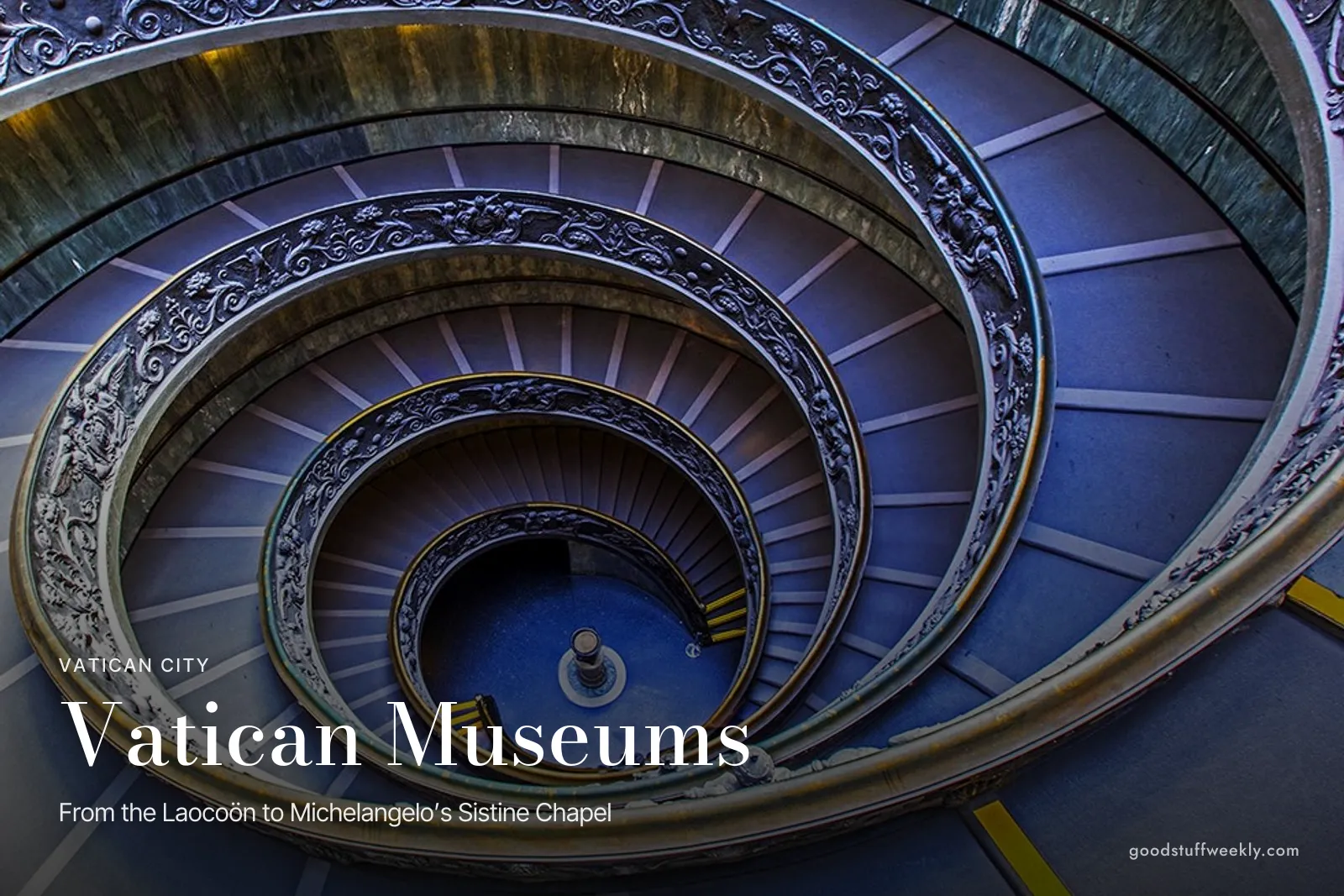
The most photographed piece of design is a double-helix ramp, the so-called Bramante Staircase in the modern exit area, built in 1932 by Giuseppe Momo. Two spirals wind around each other so that people can go up and down without meeting. Momo's version echoes an earlier Renaissance original by Donato Bramante, which lies in another part of the complex.
The Pinacoteca building sits apart from the main route, in a separate hall opened in 1932 that many visitors miss entirely. It is worth the detour: the rooms are calm, well lit, and organised by period, which makes them an easier introduction to Italian painting than the crowds in the Sistine corridor.
Online Collections & Research
You can prepare for a visit without leaving your sofa. The museums' official website publishes ticket calendars, thematic itineraries and short introductions to the major rooms. Several galleries, including the Sistine Chapel and the Raphael Rooms, have virtual tours that give a sense of the scale and lighting before you arrive.
For researchers, the Vatican Library and the Vatican Apostolic Archive sit close by inside Vatican City, though access is separate and needs formal accreditation. Students of art history often combine a museum day with an application to these institutions.
Visitor Experience
Most people follow a one-way route that runs from the Pio-Clementino sculpture rooms through the Gallery of Maps and the Raphael Rooms and ends in the Sistine Chapel. A steady pace takes two hours at the very least, and three feels far more comfortable if you want to linger in the Raphael Rooms.
- Go early or late. Booking the first slot of the morning or an afternoon slot after 2 pm noticeably thins the crowds.
- Book ahead. Online timed-entry tickets exist for a reason; the ticket-office queue can be long, especially between April and October.
- Wear comfortable shoes. The walk from the entrance to the Sistine Chapel is long, and stone floors are unforgiving.
- Eat outside or in the on-site cafeteria. Food is not allowed inside the galleries, and there is little seating along the route.
- Save the Sistine Chapel for the end, but not your energy. Michelangelo's ceiling is best viewed while you are still able to look up for a few minutes.
Planning Your Time
A workable morning at the Vatican Museums starts with a slot at 8:00 or 8:30 am, when the corridors are still half empty. Spend the first half hour in the Pio-Clementino courtyard and the Belvedere Torso room, then walk without stopping through the Gallery of the Candelabra and the Gallery of Tapestries so that you arrive at the Gallery of Maps with time to look up. The Raphael Rooms usually clog by 10:00, so try to reach the School of Athens before then. Leave the Sistine Chapel for last, when your eyes are used to the scale of everything you have seen.
Seasons matter more than days here. July and August put long queues outside before opening, while January, February and November are noticeably calmer. Wednesday mornings and the free last Sunday are the two heaviest times, so choose a different day if you can. If your legs are giving out after the chapel, the Pinacoteca sits away from the main flow and offers benches and quiet.
Visit
- Monday to Saturday: 8:00 am – 8:00 pm, with the last admission at 6:00 pm.
- Last Sunday of the month: 9:00 am – 2:00 pm, last admission 12:30 pm. Admission is free on this day, and queues can be very long.
- Closed: Other Sundays and selected religious and public holidays, including Easter Sunday, 29 June (Saints Peter and Paul) and 25 December.
Hours can change for papal events and holidays, so check the museums' official calendar close to your travel date.
Tickets
An online ticket for an adult costs about €25 (the €20 entrance fee plus a €5 booking fee); buying at the ticket office avoids the booking fee but often means a long wait. Guided or skip-the-line packages sold by third parties cost considerably more, with prices around €32–39 quoted for entry plus an audio guide. Reduced rates apply for children and students, and very young children go in free. Always check official prices before booking, and beware of resellers who add heavy mark-ups.
Because the free last-Sunday slot is so popular, many visitors would do better to pay for a weekday morning entry and see the galleries in relative calm.
Getting There
The museums are on the northern edge of Rome, a short walk from St. Peter's Square. The entrance is on Viale Vaticano, reached on foot from the following stations:
- Metro Line A: Ottaviano–San Pietro (about 10 minutes on foot) or Cipro (about 10–12 minutes).
- Bus and tram: Lines that stop near Piazza del Risorgimento are the most convenient; check current routes in a journey-planning app.
Taxis can drop you at the Viale Vaticano queue area, but the streets around the entrance are congested at peak times.
Accessibility & Visitor Services
The route through the museums is long, and much of it is level, with lifts serving the main sections and a separate entrance for visitors who cannot manage crowds or stairs. Ask the staff at the entrance about the accessible shortcut to the Sistine Chapel, which skips the stairways. Benches are scarce along the Gallery of Maps, so factor in rest stops. Audio guides are offered in many languages, and the cloakroom near the entrance takes anything larger than a small daypack.
Who Is It For?
- Art history students who want to see Raphael, Michelangelo and Caravaggio in the buildings where they worked.
- Travellers interested in Rome who prefer to combine ancient and Renaissance layers in one visit.
- Families, although children under about eight may find the crowds and quiet rules tiring; the Gallery of Maps and the Egyptian mummies tend to hold their attention best.
- Photographers, who can shoot in most galleries without flash, but not in the Sistine Chapel.
Things to Know
- Dress code is checked at the door: Shoulders and knees must be covered by everyone, and hats come off inside; staff refuse entry without exception.
- Silence in the Sistine Chapel: Guards ask for quiet and forbid photography, and they will move you along if the room becomes crowded.
- Last Sunday opening: The free last Sunday of the month is the busiest day of the year, with a queue that can stretch around the walls.
- Follow the one-way route: Once you enter the main sequence there are few exits, so use the toilets and the café before you start.
- Combine with St. Peter's: Only certain guided groups may walk from the Sistine Chapel directly into the basilica, so ask about current rules rather than assuming.
- Beware of resellers: Official tickets come from the museums' own booking site; third-party offers add heavy mark-ups.
Explore the Vatican Museums
The Vatican Museums reward preparation more than most attractions. Book a timed ticket, decide which rooms matter most to you, and pace yourself so that Michelangelo's ceiling arrives while you still have energy left to look up. Check the official website for the latest opening days, prices and closures before you go.
Visit the Vatican Museums
For current opening hours, tickets, accessibility services and exhibitions, visit the official Vatican Museums website before you travel.
Looking for more? Browse all museums on Good Stuff Weekly.
Last updated