Louvre Museum
The Louvre Museum in Paris is one of the world’s largest museums, with art and objects spanning almost 10,000 years and an online database of 500,000+ works.
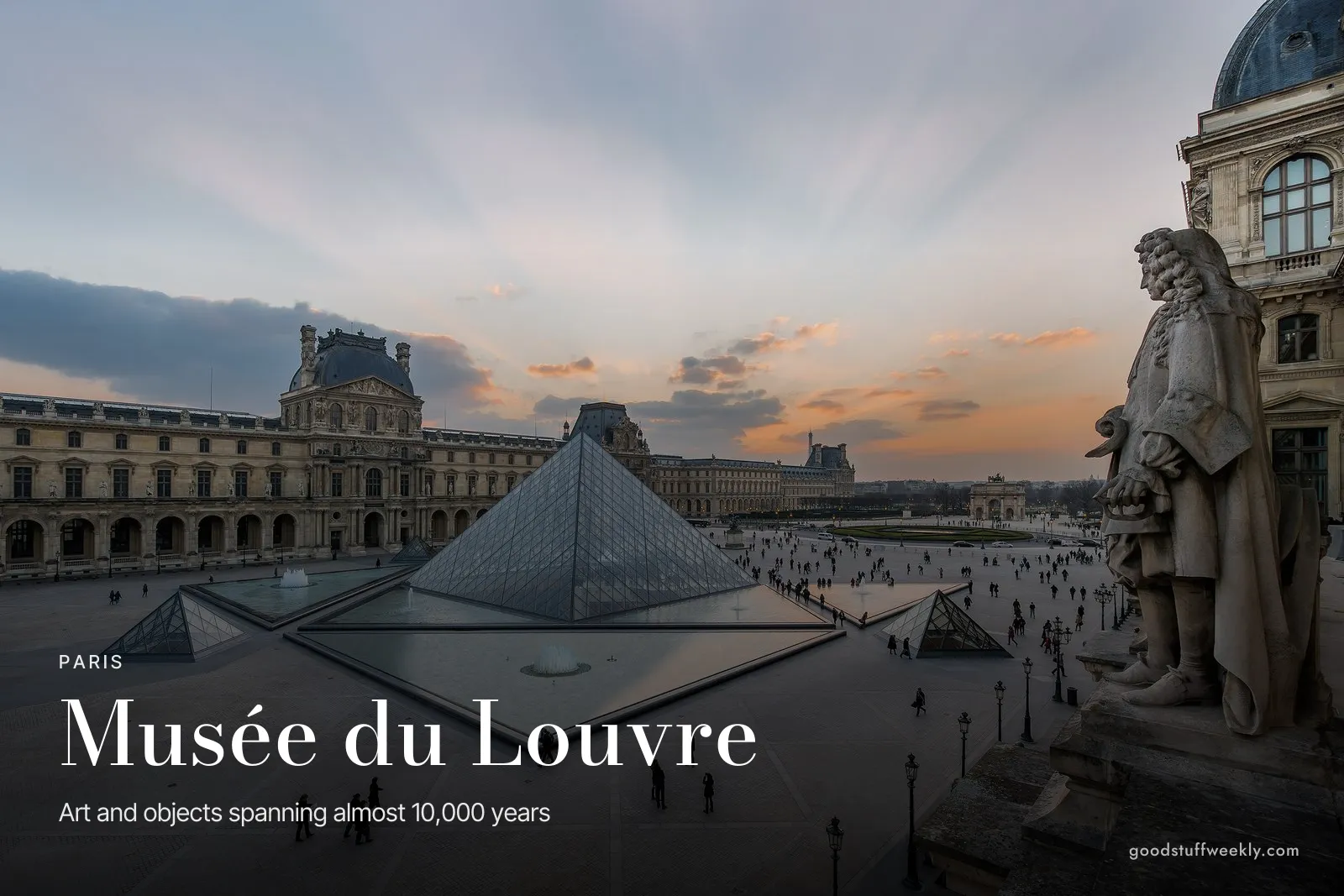
The Louvre Museum in Paris is one of the world's largest and most internationally recognized museums, bringing together art and objects spanning almost 10,000 years of history. Located in the former royal palace of the Louvre, the museum combines extensive permanent collections with research, education, visitor programmes and digital resources.
Its collections extend far beyond the works most commonly associated with the museum. Paintings, sculptures, drawings, prints, furniture, jewellery, textiles, archaeological objects, manuscripts, decorative arts and objects from ancient civilizations are all represented across its curatorial departments.
About the Louvre Museum
The Louvre's history as a museum dates to 1793, when it opened to the public during the French Revolution. The institution occupies the former Louvre Palace, a complex whose history stretches back much further and whose architecture has been transformed repeatedly over the centuries.
Today, the museum brings together collections from different civilizations and periods under a number of curatorial departments. These include Near Eastern Antiquities, Egyptian Antiquities, Greek, Etruscan and Roman Antiquities, Islamic Art, Paintings, Sculpture, Prints and Drawings, Decorative Arts and the History of the Louvre. The Musée National Eugène-Delacroix is also administratively attached to the Louvre.
The museum is not only an exhibition institution. Its teams also conduct research, document and conserve works, develop educational programmes and maintain a large digital collection that can be explored online.
The Collection
The Louvre's collections encompass more than 500,000 works in its collections database, covering works belonging to the Louvre and the Musée National Eugène-Delacroix. The database is updated regularly through the work of curators, researchers, documentation teams and other museum specialists.
The online collection can be explored through categories including:
- Architecture & Decoration
- Arms & Armour
- Arts of the Book
- Jewellery & Finery
- Drawings & Prints
- Writing & Inscriptions
- Furniture
- Coins & Medals
- Funerary Monuments
- Objects of Worship
- Domestic Items
- Personal Items
- Tools & Instruments
- Paintings
- Seals & Glyptic Art
- Sculptures
- Stelae
- Textiles & Clothing
- Vessels & Dishes
The database includes works regardless of their current location. An object may be on display at the Louvre, displayed in the gardens, held in storage, or on long-term loan elsewhere. Individual records provide information about the work and its location.
What Can You Explore?
Paintings
The Louvre's painting collection includes works from major European traditions, with particularly extensive holdings of French and Italian painting alongside works from Northern Europe, Spain and other regions.
Sculpture
The museum's sculpture collections cover ancient and European traditions and include works from different periods, materials and cultures.
Drawings & Prints
The Prints and Drawings collections provide an extensive resource for exploring works on paper, including drawings, prints and related material.
Decorative Arts
Furniture, jewellery, textiles, ceramics and other objects of decorative and material culture form an important part of the Louvre's collections.
Ancient Civilizations
The museum's collections extend far beyond European art, with departments dedicated to Egyptian, Near Eastern, Greek, Etruscan, Roman and other ancient cultures.
Islamic Art
The Louvre's Islamic Art collection contains objects representing different periods and regions of the Islamic world, offering another perspective on the development of artistic and material traditions.
Architecture & Decoration
The building itself is part of the museum experience. Architectural elements and decorative schemes throughout the former palace provide an opportunity to explore the history of the Louvre alongside the objects displayed inside it.
Museum Architecture & History
The Louvre is both a museum and a historic architectural complex. Its buildings developed over centuries, beginning with the medieval fortress and continuing through its transformation into a royal residence and eventually a public museum.
The Pyramid, designed by architect I. M. Pei and opened in 1989, has become one of the museum's most recognizable modern architectural elements. It now serves as the principal entrance for visitors.
Inside, historic palace spaces sit alongside later interventions and exhibition architecture. This mixture of old and new makes the building itself an important part of a visit, particularly for visitors interested in architecture, interior design and decorative arts.
The Louvre's grounds also extend beyond the museum galleries. The Tuileries Garden forms part of the Louvre's wider National Estate and provides another way to experience the institution's architectural and cultural setting.
Online Collections & Research
The Louvre's digital collections are particularly useful for anyone researching art, design, visual culture or material history.
The Collections website provides:
- Full-text search
- Advanced search
- Filters by date
- Filters by collection
- Filters by location
- Filters by type of work
- Filters by artist or maker
- Themed albums
- An interactive map of works currently on display
- Downloadable data and documentation
Individual collection records have permanent URLs, making them useful as research references.
For designers, artists, students and researchers, the online database can therefore be useful even without a physical visit.
Visitor Experience
The scale of the Louvre means that a visit can be approached in very different ways. Visitors can focus on a particular department, period, collection or group of works rather than attempting to see the museum as a whole.
The Louvre also provides visitor trails organized around particular interests. Its collection-visit programme, for example, rotates through subjects ranging from Greek and Egyptian antiquities to Italian, French and Northern European painting and decorative arts.
The museum offers audio guides in nine languages: French, English, Spanish, German, Italian, Portuguese, Chinese, Korean and Japanese. The audio guide is currently available for €6, subject to availability.
There are also restaurants, cafés, bookshops, gift shops, information desks, cloakrooms and other visitor services within the museum complex.
Visit
The Louvre is currently open every day except Tuesday.
Monday, Thursday, Saturday & Sunday: 9:00–18:00
Wednesday & Friday: 9:00–21:00
Tuesday: Closed
Last entry is one hour before closing, and visitors are asked to leave the exhibition rooms 30 minutes before closing.
The museum is closed on 1 January, 1 May and 25 December. It remains open on other public holidays unless they fall on a Tuesday.
Opening hours and gallery availability can change, so visitors should check the official website before travelling.
Tickets
As of January 14, 2026, standard individual admission is:
EEA citizens/residents: €22
Non-EEA citizens/residents: €32
Admission includes access to the permanent collections and temporary exhibitions and also provides same-day or following-day access to the Musée National Eugène-Delacroix, subject to the applicable conditions.
Admission is free for several categories, including visitors under 18 and EEA citizens or residents under 26 who meet the relevant requirements. The museum recommends booking a timed ticket even for visitors who qualify for free admission.
The Louvre is also free for all visitors on the first Friday of each month after 6 p.m., except in July and August, and on 14 July.
Getting There
The Louvre's principal entrance is through the Pyramid.
The closest metro stations include:
- Palais-Royal / Musée du Louvre — Lines 1 and 7
- Pyramides — Line 14
The museum can also be reached by numerous bus routes. An underground car park is located at 1 Avenue du Général Lemonnier, with access to the museum through the Galerie du Carrousel entrance.
Accessibility & Visitor Services
The Louvre provides accessibility measures for visitors with different needs, including visitors with physical disabilities, hearing impairments, visual impairments, and developmental or learning disabilities.
The museum also provides information desks, free Wi-Fi, toilets, cloakroom facilities and equipment loans. Prams are permitted, and certain equipment can be borrowed from the museum.
Visitors should check the official accessibility information before travelling for details relevant to their specific needs.
Who Is It For?
The Louvre can be relevant to a wide range of creative and cultural audiences, including:
- Artists
- Designers
- Illustrators
- Photographers
- Art and design students
- Researchers
- Historians
- Architects
- Makers
- Creative professionals
- Art and culture enthusiasts
Its breadth is particularly useful for people interested in how visual language, materials, techniques, objects and artistic traditions have developed across different periods and cultures.
For designers and makers, the museum's furniture, textiles, jewellery, decorative arts, architecture and object collections can be as relevant as its better-known paintings and sculptures.
For researchers, the online collection database provides an additional resource that can be explored without visiting Paris.
Things to Know
It's enormous: The Louvre's collections cover almost 10,000 years of art history, so a single visit can only cover a small part of the museum.
Plan around an interest: Choosing a department, period, collection or visitor trail beforehand can make a visit more manageable.
Check room closures: Some galleries may be temporarily closed because of renovation or maintenance. The Louvre publishes a schedule of room closures.
Book a time slot: The museum recommends timed-ticket reservations, including for visitors eligible for free admission.
The building is part of the experience: The former royal palace, its courtyards, interiors and architectural additions are themselves worth exploring.
Look beyond the famous works: The Louvre's collections include hundreds of thousands of objects across painting, sculpture, decorative arts, archaeology, textiles, furniture, jewellery, works on paper and other categories.
Explore before you visit: The online collections database can help you identify works, departments and areas of interest before arriving.
Explore the Louvre
Interested in exploring the Louvre?
Visit the Louvre
For current visitor information, opening hours, tickets, accessibility services, visitor trails and the complete online collections database, visit the official Louvre website.
Looking for more? Browse all museums and resources on Good Stuff Weekly.
Last verified: September 27, 2026
Last updated