Shanghai Museum East
Shanghai Museum East is the Shanghai Museum’s new branch in Pudong, opened in 2024, with ancient Chinese bronzes, jade, ceramics and painting. General admission is free.
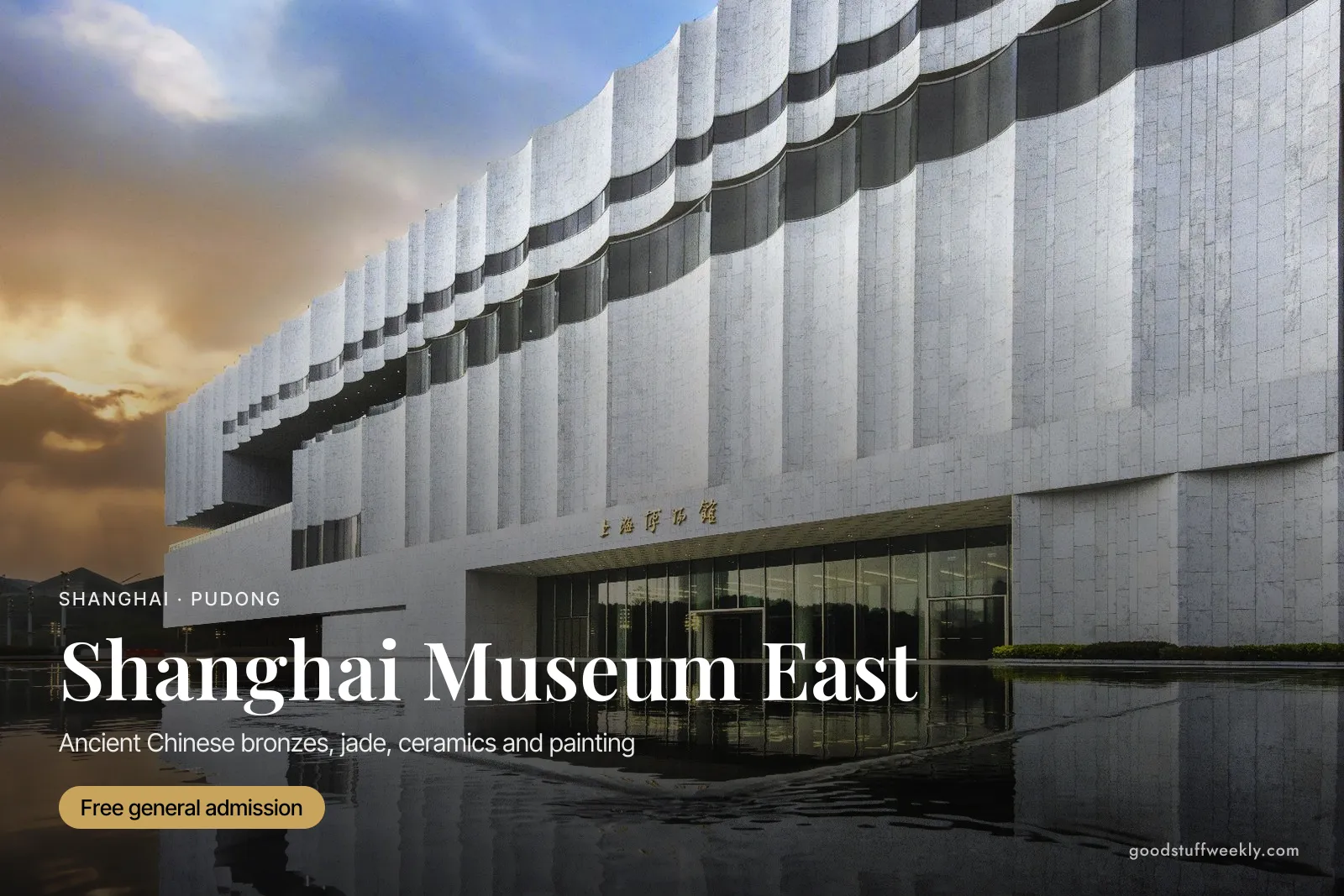
Shanghai Museum East: A New Home for China's Ancient Art in Pudong
Shanghai has long been a city of skyscrapers, but its newest cultural landmark looks back three thousand years. Shanghai Museum East, the second site of the celebrated Shanghai Museum, opened in stages during 2024 on Century Avenue in Pudong. It brings a huge amount of additional gallery space to a collection best known for its bronzes, ceramics, jade and painting, and it does so with free admission.
The museum can accommodate up to 20,000 visitors a day, and its layout gives large objects room to breathe. Visitors used to the compact, round-topped building in People's Square across the river will notice the difference at once: the East building is far larger, with room to display many more objects.
About the Museum
The Shanghai Museum was founded in 1952 and has been housed since 1996 in its distinctive building at People's Square, whose square-base, round-top form evokes an ancient bronze vessel. Its collection, one of the world's best of ancient Chinese art, outgrew the site over the decades, and the city decided to build an eastern branch to hold more objects and reach a new public.
Construction began in September 2017 on Century Avenue, close to the Shanghai Science and Technology Museum. The building, designed by a team from Tongji University, has six storeys above ground and two below, a total floor area of about 113,200 square metres, and a height of roughly 45 metres. On 2 February 2024, its first gallery, dedicated to bronzes, opened to the public, and further sections followed during the year as the museum grew toward its full opening.
The Collection
Shanghai Museum East draws on the Shanghai Museum's wider holdings of ancient Chinese art, which are especially renowned for bronzes, ceramics, jade, sculpture, calligraphy, painting, seals and coins. The new branch gives much more of that material a permanent home on public view.
Its permanent exhibition is organised into eight halls: six on ancient Chinese art, plus one on the history of Shanghai and one on ceramics. Alongside them are learning and digital spaces, including the Curio-City interactive area and the Digital Gallery.
What Can You Explore?
The permanent exhibition is organised into eight halls. Six focus on ancient Chinese art, and the remaining two look at the history of Shanghai and at ceramics.
- Bronzes. The bronze hall was the first to open, and it is a good place to begin. Ritual vessels from the Shang and Zhou dynasties, used in ancestral ceremonies, carry intricate patterns and inscriptions that record family and state events.
- Sculpture. Buddhist and secular figures in stone, wood and metal show how foreign ideas and local traditions mixed along the Silk Road.
- Jade and seals. Delicate objects from the Neolithic period onward, from ritual discs to personal seals, illustrate the long importance of jade in Chinese culture.
- Calligraphy and painting. Scrolls and album leaves are rotated regularly because silk and paper are sensitive to light, so returning visitors often find new works.
- Ceramics. The museum traces Chinese ceramic history from early pottery to the refined glazed wares of later dynasties, and it presents the story of a craft that had global impact.
- Shanghai history. A gallery devoted to the city places its development in a long context, from a fishing settlement to a commercial capital.
- Curio-City. A 1,900-square-metre interactive space on floors three and four, aimed at ages 6 to 18, with programmes such as "Little Archaeologist" and "Little Restorer" that let children handle replicas and try conservation techniques.
- Digital Gallery. A media-rich space that presents "Poetic Jiangnan," a show using digital technology to bring classical paintings from the Five Dynasties to the Qing dynasty to life.
- Open conservation laboratory. A glass-walled workspace where you can watch conservators restore and study artefacts.
Museum Architecture & History
The building is monumental in scale. Its six upper floors and two basement levels give the galleries room for large bronzes and sculpture, and individual visitors enter through the East Gate at the B1 level, while groups use the North Gate.
The museum's shop, at around 1,000 square metres on the first floor, is one of the larger museum shops in the city, and cafés and rest areas are spread across several levels.
Online Collections & Research
The Shanghai Museum's English website has information on both branches and their current exhibitions, while the Digital Gallery inside the East building provides an immersive look at painting collections that cannot be constantly displayed. Educational programmes and workshops for families and school groups are listed on the museum's website and WeChat account.
Visitor Experience
Set aside at least three hours if you want to explore several halls, and more if you plan to reserve a slot for Curio-City or the Digital Gallery, which need separate bookings. Older children and adults who enjoy hands-on activities will find the interactive areas particularly rewarding.
- Start with bronzes. They are the museum's strongest collection and set the context for other galleries.
- Book special areas early. Curio-City and the Digital Gallery require advance reservations.
- Bring your ID. A valid identity document is required to enter, and foreign visitors should carry their passport.
- Pair it with the People's Square branch. Seeing both sites on separate days gives you a fuller picture of the collection.
- Pace yourself. Cafés and rest areas on several levels make it easy to break the visit into stages.
Planning Your Time
Begin with the Bronze Exhibition Hall, where the museum's first galleries opened in 2024, and take your time with the ritual vessels and inscriptions. Move on to the ceramics and jade halls, then the sculpture and painting galleries, and finish in Curio-City or the Digital Gallery if you have booked a slot. Leave time for the open conservation laboratory, where you can watch conservators at work through glass. A full visit takes about four hours, and the rest of the day can be spent in the Science and Technology Museum next door.
Weekday mornings are calm, while weekends and Chinese public holidays bring large groups and long lines at the security gate. Booking Curio-City and the Digital Gallery early is essential, because these spaces are limited. Summer heat and winter cold make the indoor route pleasant all year, and the large atrium is a comfortable place to rest between halls. If you also plan to visit the People's Square branch, split the two on different days.
Visit
The museum is open from Wednesday to Monday, 10:00 am to 6:00 pm, with last entry at 5:00 pm. It is closed on Tuesdays, except on national holidays. Opening arrangements can change, so check the museum's official channels before your visit.
Tickets
General admission is free, and individual visitors do not need to reserve in advance. Groups of 20 or more must book at least seven days ahead. Temporary exhibitions are ticketed separately and can be purchased online or at the information desk. Curio-City and the Digital Gallery require separate advance reservations, made through the official website or the WeChat mini programme.
Getting There
The museum is on Century Avenue in Pudong, beside the Shanghai Science and Technology Museum.
- Metro Line 2: Shanghai Science and Technology Museum station, Exit 8.
- Metro Line 4: Same station, Exit 2.
- Metro Line 6: Pudian Road station, Exit 1.
- Bus: Routes including 638, 975 and 987 stop nearby.
A taxi or ride from the Bund takes about 20 to 30 minutes, depending on traffic.
Accessibility & Visitor Services
The building is large but arranged on lifts and wide corridors, with wheelchairs and strollers available at the information desk. Restrooms include accessible and family facilities on several floors, and lockers are provided for bags. Entry requires an ID check at the B1 East Gate for individuals and at the North Gate for groups. Audio and smart guides can be rented for between 20 and 60 RMB, and cafés and restaurants are spread across levels.
Who Is It For?
- Students of Chinese history, art and archaeology who want to see excellent examples in context.
- Craft and design enthusiasts, who will find lacquer, jade, ceramics and metalwork of exceptional quality.
- Families, thanks to Curio-City and the workshops.
- Travellers to Shanghai who want a cultural stop that goes beyond the skyline.
Things to Know
- ID is required: Bring a passport or ID card, since entry checks are strict at both gates.
- Free general admission: Individual visitors do not need to book for the main halls, but groups of 20 or more must reserve a week ahead.
- Reserve special areas: Curio-City and the Digital Gallery need separate advance bookings through the website or WeChat mini programme.
- Strict gallery rules: Touching objects, flash photography, tripods, selfie sticks and live streaming are not allowed.
- No food in the halls: Eat in the cafés and restaurants provided on the various floors.
- Closed on Tuesdays: Except on public holidays, the museum is closed on Tuesdays, and the last entry is at 5:00 pm.
Explore Shanghai Museum East
Shanghai Museum East gives visitors a modern, spacious way to encounter ancient Chinese art. Bring your passport, choose a few halls to focus on, book Curio-City or the Digital Gallery in advance if you want them, and check official channels for current hours and exhibitions before you set out.
Visit the Shanghai Museum East
For current opening hours, tickets, accessibility services and exhibitions, visit the official Shanghai Museum East website before you travel.
Looking for more? Browse all museums on Good Stuff Weekly.
Last updated