National Museum of Korea
The National Museum of Korea in Seoul traces Korean art and history from prehistory to the Joseon dynasty, with the Silla gold crown, Goryeo celadon and free permanent galleries.
A Museum Where Korea's Long Story Is Laid Out Room by Room
Seoul has palaces, temples and a skyline that rewrites itself every decade, but if you want to grasp how those pieces fit together, the National Museum of Korea in Yongsan is the place to start. Its galleries follow the peninsula from the Paleolithic hunters through the Three Kingdoms, the Goryeo court, the Joseon dynasty and beyond, then step outside Korea to look at Central Asia, India, China and Japan.
Two facts make it unusually easy to approach. The permanent galleries are free of charge, and the building sits a short walk from a subway station in the middle of the capital. About 3.78 million people visited in 2024, a big number for a country of this size, and the crowd is a healthy mix of school groups, local families and international travellers.
About the Museum
The museum's roots reach back to 1909, when the Imperial Household Museum opened in Changgyeonggung Palace during the final years of the Korean Empire. After Korea's liberation in 1945, the National Museum was formally established, drawing on that older collection along with objects gathered under Japanese rule.
Its early decades were restless. During the Korean War, roughly 20,000 pieces were packed up and sent south to Busan for safekeeping. Afterwards the museum moved between several sites, including Deoksugung and Gyeongbokgung palaces, before settling in a purpose-built complex on former Yongsan Garrison land, which opened to the public in October 2005.
The current building is enormous. With around 295,000 square metres of floor space, it ranks among the largest museums in the world by area, and it is built to withstand a magnitude 6.0 earthquake. Long, calm hallways of pale stone, high ceilings and skylights give the interior a serenity that suits objects made for shrines, scholars' studios and royal courts.
The Collection
The National Museum of Korea has more than 310,000 objects in its holdings, with roughly 15,000 on display at any one time. They cover the whole span of Korean history, from Paleolithic tools to Joseon paintings and modern gifts, plus a substantial group of Asian art from neighbouring regions.
The permanent display is divided into six gallery groups: Archaeology, Medieval and Early Modern History, Calligraphy and Painting, Sculpture and Crafts, Asian Art, and Donations. Because fragile paintings and textiles rotate out of view, the exact selection changes from visit to visit.
What Can You Explore?
The museum holds more than 310,000 objects, though only around 15,000 are on view at a time. Six permanent gallery groups organise them.
- Archaeology and Ancient History. Stone tools, Bronze Age dolmen culture, and the great burial treasures of Silla, Baekje and Gaya. The gold crown from a fifth-century Silla tomb, with its branching antlers and jade pendants, is the icon of the collection. Look at how thin the gold is and how delicately the spangles were cut.
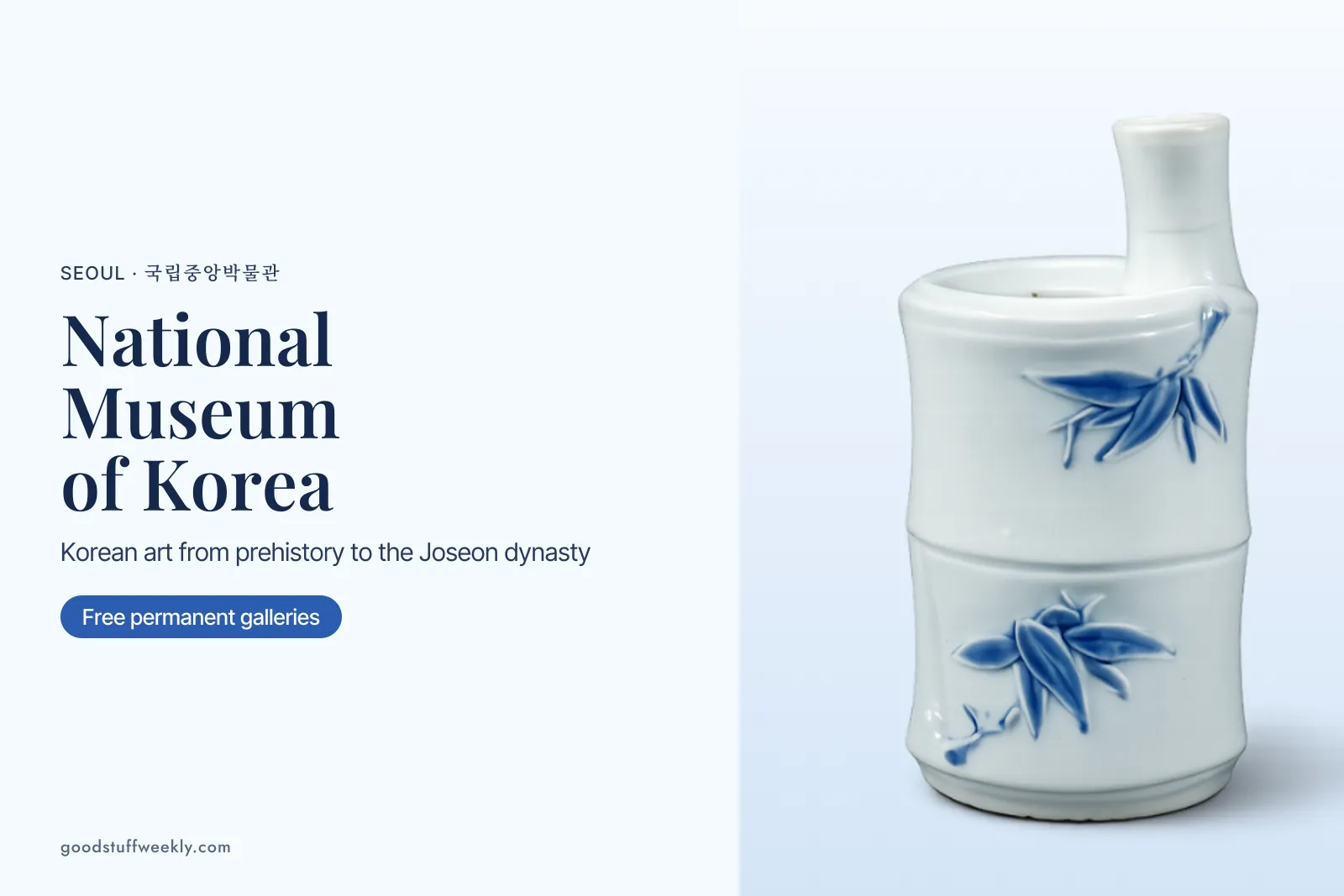
- Medieval and Early Modern History. Goryeo dynasty court life, Buddhist manuscripts, and the pale blue-green celadon that made Korean potters famous across East Asia. Joseon-era white porcelain, including moon jars, fills nearby cases.
- Calligraphy and Painting. Screens, hanging scrolls and album leaves by Joseon masters. Landscapes and genre scenes are rotated regularly because light damages silk and paper, so what you see may differ from a friend's photos.
- Sculpture and Crafts. Gilt-bronze Buddhist statues, lacquerware inlaid with mother-of-pearl and metalwork. The Pensive Bodhisattva from the seventh century, seated with one leg crossed and a hand to the cheek, is displayed in its own hushed room and often draws a quiet crowd.
- Asian Art. A wide sweep of objects from Central Asia, China, India, Southeast Asia and Japan, useful for tracing how Buddhism and trade routes shaped Korean styles.
- Donations Gallery. Holdings offered by private collectors, including major gifts from the Lee Kun-hee family collection received in 2021, which brought thousands of works into public care.
Outside, the ten-storey stone pagoda from Gyeongcheonsa temple is one of the museum's most remarkable objects. Built in the fourteenth century, it was taken to Japan in 1907 and returned in 1918, and it now stands in a dedicated hall.
Museum Architecture & History
The museum stands inside Yongsan Family Park, and the walk from the entrance to the galleries takes you across a wide stone plaza, past a reflecting pond called the Mirror Pond, and under a monumental glass-fronted lobby. The reflecting pond and its mountain backdrop make it a good place for a short rest before or after the galleries.
Outdoors, the grounds hold stone pagodas, lanterns and memorial steles arranged in open-air courtyards. If the weather is warm, the terrace above the entrance offers a view of Namsan Mountain and the rest of the city.
Online Collections & Research
For researchers and casual browsers alike, the museum's website offers an online database with photographs and descriptions of representative objects. Virtual 360-degree tours let you look around several exhibition halls, and there are digital exhibitions on themes such as Buddhist art or royal culture. A mobile app provides guidance in Korean and English.
Downloadable guidebooks are available in languages that include English, Chinese, Japanese, French, German and Spanish, which makes the museum friendly for international students who want to prepare in advance or refresh their memory afterward.
Visitor Experience
Plan for a whole morning or afternoon. A brisk walk through only the highlights, including the gold crown, the Pensive Bodhisattva and the celadon, takes about two hours; a comfortable pace across all six gallery groups can fill five.
- Children's Museum. A free space inside the complex with hands-on exhibits for younger visitors.
- Museum shop. Reproductions of celadon, tea sets, stationery and books, several of them designed exclusively for the museum.
- Cafés and restaurants. Located across the complex, from quick coffee to sit-down Korean meals.
- Special exhibitions. Large exhibitions, often with international loans, are ticketed separately. Check the schedule before your visit.
Planning Your Time
If you have three hours, use them this way. Begin on the ground floor with the Archaeology and Ancient History rooms, and stop at the Silla gold crown, since it sets the tone for everything else. Move through the Medieval and Early Modern rooms to the celadon and moon jars, then go upstairs to Calligraphy and Painting and the Sculpture and Crafts hall for the Pensive Bodhisattva. Save the Asian Art gallery and the Donations gallery for a second visit if your energy fades.
Outside, give twenty minutes to the Mirror Pond and the stone pagodas. Wednesday and Saturday evenings, when the museum stays open until 9:00 pm, are the best moments for photography on the plaza. Spring and autumn bring the most pleasant walking weather in Seoul, while summer heat makes the air-conditioned halls attractive and winter often brings crisp, empty galleries on weekday mornings.
Visit
- Monday, Tuesday, Thursday, Friday and Sunday: 9:30 am – 5:30 pm
- Wednesday and Saturday: 9:30 am – 9:00 pm
- Last admission: 30 minutes before closing
Weekday mornings are the calmest, and Saturday evening is a pleasant time to visit when the exhibits are lit and school groups have gone home. Hours can shift on public holidays, so confirm before travelling.
Tickets
General admission to the permanent exhibitions is free. Special exhibitions charge separate fees, which vary by show. Timed reservations are available for some programmes and special exhibitions, so check the official reservation system if you plan to attend a specific event.
Getting There
The nearest station is Ichon Station, served by Seoul Subway Line 4 and the Gyeongui-Jungang Line. Take Exit 2 and follow the signs; a walk of about 150 metres leads to the museum gates. Buses from central Seoul also stop nearby, and taxis can drop you directly at the main entrance.
Accessibility & Visitor Services
The galleries are laid out on wide, flat corridors linked by lifts and escalators, which suits wheelchairs, strollers and older visitors alike. Distances are long, so it helps to plan rest stops at the benches beside the main halls. Guidebooks in several languages can be downloaded before you arrive, and the free Children's Museum has its own entrance and facilities. Staff at the information desk can point out the shortest route between the ancient and Joseon galleries if your time is limited.
Who Is It For?
- Travellers who want a cultural overview before exploring palaces and temples.
- Students of Asian art who can compare Korean objects with Chinese, Japanese and Central Asian pieces in the same building.
- Families, thanks to the Children's Museum and outdoor space.
- Craft and design fans, who will find celadon, lacquer, metalwork and textiles to study up close.
Things to Know
- Rotating displays: Paintings and textiles are swapped out on a schedule, so a favourite piece may be resting in storage.
- Free but ticketed specials: Permanent galleries cost nothing, yet major special exhibitions charge separately and can require a reservation.
- Plan for size: The building is among the largest in the world by floor area, and a full visit means several kilometres on foot.
- Evening advantage: On Wednesday and Saturday the museum stays open until 9:00 pm, which makes an after-work visit possible.
- Use the park: Yongsan Family Park surrounds the museum, and the gardens are part of the experience in good weather.
- Closing dates: Public holidays such as Seollal and Chuseok change the schedule, so check before travelling.
Explore the National Museum of Korea
With no entrance fee, generous hours and a collection that stretches from prehistory to modern donations, the National Museum of Korea is one of the easiest ways to understand the country's art and history. Check the official website for current exhibitions, plan a route through the galleries that interest you most, and give yourself enough time to enjoy the grounds as well.
Visit the National Museum of Korea
For current opening hours, tickets, accessibility services and exhibitions, visit the official National Museum of Korea website before you travel.
Looking for more? Browse all museums on Good Stuff Weekly.
Last updated