National Gallery of Art
The National Gallery of Art in Washington, DC is a free museum on the National Mall, with Leonardo’s Ginevra de’ Benci, Vermeer, Rembrandt and I. M. Pei’s East Building.
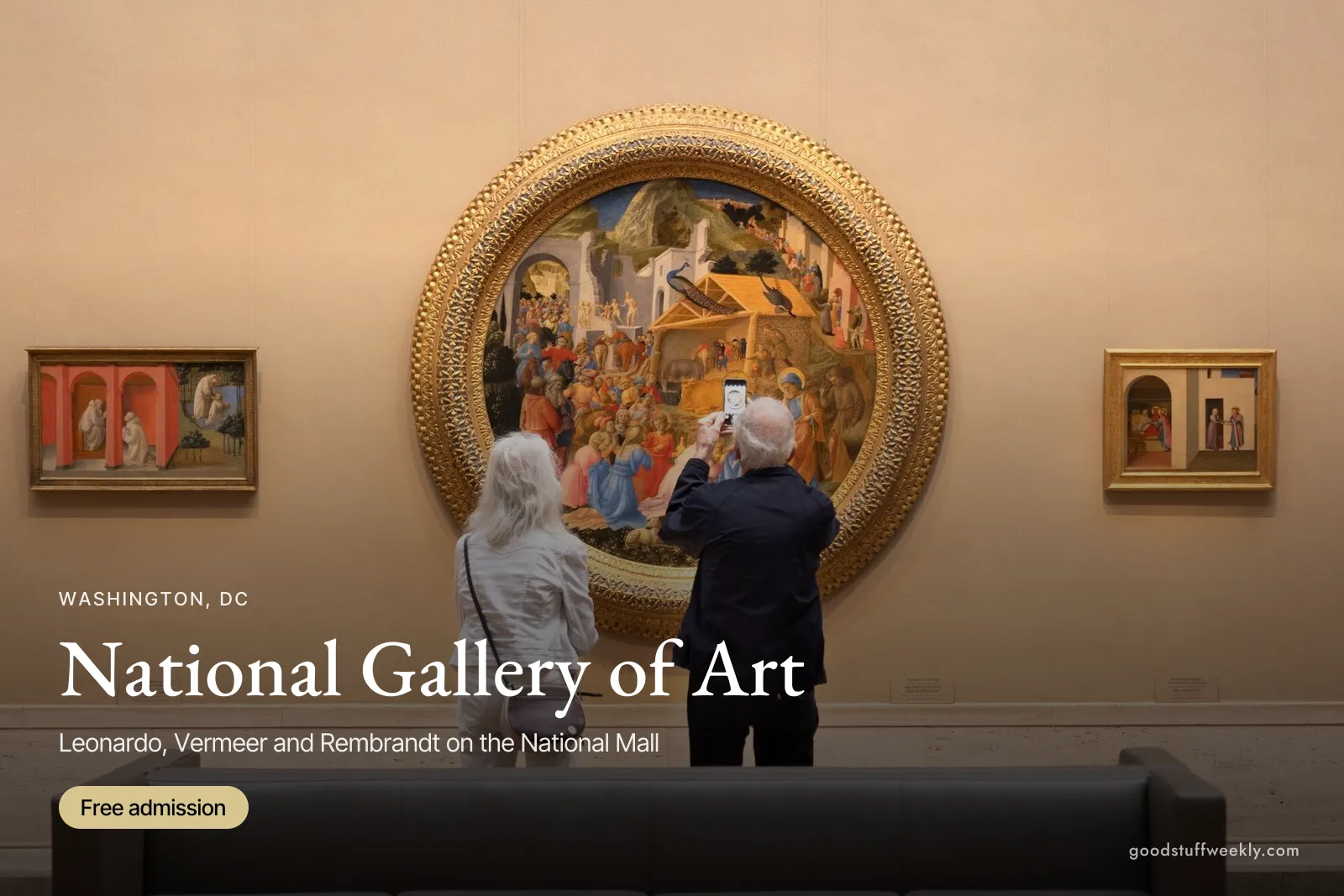
National Gallery of Art: A Free Treasure House on the National Mall
Most of Washington's great museums cluster along the National Mall, and among them the National Gallery of Art stands apart for the depth of its European painting, the reach of its modern collection and one simple fact: admission is always free. Nearly 4 million people came in 2024, which makes it the second most visited museum in the United States, and it is the only one among the country's three busiest art museums that does not charge for entry.
The gallery is spread across two very different buildings and a landscaped garden, connected by an underground concourse. You can step from a Renaissance portrait to a room of abstract expressionism without ever going outdoors, or wander outside and eat lunch beside a fountain beneath contemporary sculpture.
About the Museum
The gallery's founding has an unusually generous origin. Andrew W. Mellon, the financier who served as US Treasury Secretary, offered his personal collection of European masterpieces and the funds to build a museum for them. Congress accepted the gift through a joint resolution in 1937, and Mellon selected the architect John Russell Pope to design a building on the Mall.
Pope's neoclassical West Building, faced in pink Tennessee marble beneath a domed rotunda, was finished in 1941, and President Franklin D. Roosevelt accepted it on behalf of the American people on 17 March that year. Mellon did not live to see it open. His gift attracted other collectors, and collections donated by Samuel H. Kress, Joseph Widener, Chester Dale and Paul Mellon later transformed a single donor's vision into a comprehensive national museum.
A second, very different building followed. The East Building, designed by I. M. Pei and opened in 1978, took its shape from the trapezoidal plot of land it occupies, dividing it into two triangles. Its sharp edges and white marble are among the best-known modern buildings in the capital. The 6.1-acre Sculpture Garden, adjacent to the West Building, opened in 1999.
The Collection
The National Gallery of Art holds European and American painting, sculpture, decorative arts, photography and one of the country's largest collections of works on paper, including roughly 75,000 prints. Its scope runs from the Middle Ages to the present day, with particular strength in Italian Renaissance, Dutch and French painting, and American and postwar modern art.
The collection grew through a series of gifts rather than purchases alone. Mellon's founding donation was joined by holdings from Samuel H. Kress, Joseph Widener, Chester Dale and others, which is why the galleries feel so consistently strong across periods.
What Can You Explore?
The gallery presents European and American art from the Middle Ages to the present, along with a huge collection of prints, drawings and photographs. Some works everyone wants to see.
- Leonardo da Vinci, Ginevra de' Benci. Painted around 1474 to 1478, this portrait of a young Florentine woman is the only painting by Leonardo in the Western Hemisphere. The back is painted too, with a wreath of juniper, a play on her name.
- Johannes Vermeer. Woman Holding a Balance and other quiet interiors, part of one of the strongest groups of Dutch painting in the Americas.
- Rembrandt. A late self-portrait from 1659 shows the artist at his most searching.
- Claude Monet and the Impressionists. Woman with a Parasol and dazzling canvases by Renoir, Degas and Cassatt.
- Vincent van Gogh. His late self-portrait and other works from his final years hang in the West Building.
- Jackson Pollock and Mark Rothko. The East Building holds essential abstract expressionist works, including Pollock's drip paintings and a room of Rothko's large colour fields.
- Alexander Calder. A huge mobile made for the East Building hangs from the ceiling of the atrium, tying the architecture to the collection.
- Prints, drawings and photographs. With roughly 75,000 prints in the collection, the gallery is a major centre for works on paper, and rotating displays show them in small, well-lit rooms.
- American art. Paintings by Winslow Homer, Thomas Eakins, Georgia O'Keeffe and Edward Hopper trace the story of art in the United States.
Museum Architecture & History
The two buildings show how museum design shifted between the mid-twentieth century and the postwar era. The West Building's marble halls, fountains and rotunda are calm and formal, with long enfilades of rooms arranged by period and national school. The East Building's soaring atrium is full of daylight, angles and cantilevered walkways.
Outside, the Sculpture Garden is a quiet place for a break. It has trees, seating and a large fountain that becomes an ice-skating rink in winter, and it displays large-scale works by artists including Louise Bourgeois, Roy Lichtenstein and Claes Oldenburg. In summer it has extended hours, and the area hosts jazz evenings.
Online Collections & Research
The gallery's website lets you browse its collection of tens of thousands of objects, with many high-resolution images available for free use. The National Gallery's library and image collections serve researchers and students, and its programmes include lectures, films, concerts and family activities in the buildings and online.
Visitor Experience
Because both buildings are large, decide whether you want the older European art or the modern and contemporary work before you go. A concentrated visit to the West Building's highlights takes around two hours; an afternoon covers both buildings and the garden.
- Follow the chronological route in the West Building. The main floor runs from the thirteenth to the nineteenth century, so you can trace how painting changed.
- Take the underground concourse. It connects the two buildings and includes a moving walkway, a café and a shop.
- Look for the small rooms. Some of the most affecting works, including early Italian panels and Dutch still lifes, are in intimate galleries.
- Take a break outside. The Sculpture Garden is a good place to relax between buildings.
- Come on a weekday. Mornings are quieter, and school groups are more common on midweek afternoons.
Planning Your Time
A satisfying route through the National Gallery of Art starts in the West Building rotunda, then moves west through the early Italian rooms to the Leonardo, Ginevra de' Benci, on the ground floor of the main building. Continue to the Dutch rooms for Vermeer and Rembrandt, and the French galleries for Monet and Van Gogh. Take the underground concourse to the East Building for the Pollock and Rothko rooms and the Calder mobile, then finish outdoors in the Sculpture Garden.
Weekday mornings are calmest, while spring cherry blossom weeks and summer weekends bring crowds to the Mall. In winter the Sculpture Garden turns into an ice rink, and in summer it stays open later for evening events. Because admission is free and the gallery opens daily, you can split a visit into two shorter trips, which many Washington residents do. The concourse between the buildings has a café and a moving walkway, both useful for tired feet.
Visit
The National Gallery of Art is open every day from 10:00 am to 5:00 pm, except on 25 December and 1 January. The Sculpture Garden may have different hours depending on the season, including extended summer hours, so check the website for the latest information.
Tickets
Admission to all collections is always free, and no ticket is required for the permanent collection. Special exhibitions are also generally free, though timed passes may be needed for popular shows. Check the website ahead of time for any advance registration.
Getting There
The gallery is on the National Mall, and its two main buildings are on Constitution Avenue.
- Metro: Judiciary Square (Red Line) is about a 10-minute walk to the East Building. Archives–Navy Memorial–Penn Quarter (Green and Yellow lines) and Smithsonian (Blue, Orange and Silver lines) are also nearby.
- Bus and Circulator: Several routes stop along Constitution Avenue and 7th Street.
- On foot: The gallery is a natural stop when walking between the US Capitol and the Washington Monument.
Accessibility & Visitor Services
Both buildings have step-free entrances, lifts and ramps, and the concourse between them is level, so wheelchair users and families with strollers can move easily through the whole campus. Wheelchairs and strollers are available at the information desks near each entrance. Seating is placed throughout the long West Building galleries. Cafés, cloakrooms and gift shops are found in both buildings and in the concourse.
Who Is It For?
- Art history students who want to see the story of Western painting in one place.
- Photographers, who will find important holdings and changing exhibitions.
- Families, because of the free admission and outdoor space.
- Visitors to Washington who want a break from monuments and politics.
Things to Know
- Always free: There is no admission fee, and no ticket is required for the permanent collection.
- Not part of the Smithsonian: The gallery is a separate institution from the Smithsonian museums along the Mall.
- Two buildings, two moods: The West Building holds older European and American art, while the East Building is devoted to modern and contemporary work.
- Sculpture Garden hours: Its schedule changes with the season, including extended hours in summer.
- Security screening: Expect a bag check at each entrance, especially on busy weekends.
- Look for Ginevra: Leonardo's portrait is the only painting by him in the Americas, and it has a painted reverse worth a look.
Explore the National Gallery of Art
Free, central and enormous, the National Gallery of Art is easy to fit into a trip to Washington, and easy to underestimate. Pick a wing, follow the works that catch your eye, and check the official website for current hours, exhibitions and events before you go.
Visit the National Gallery of Art
For current opening hours, tickets, accessibility services and exhibitions, visit the official National Gallery of Art website before you travel.
Looking for more? Browse all museums on Good Stuff Weekly.
Last updated