Tate Modern
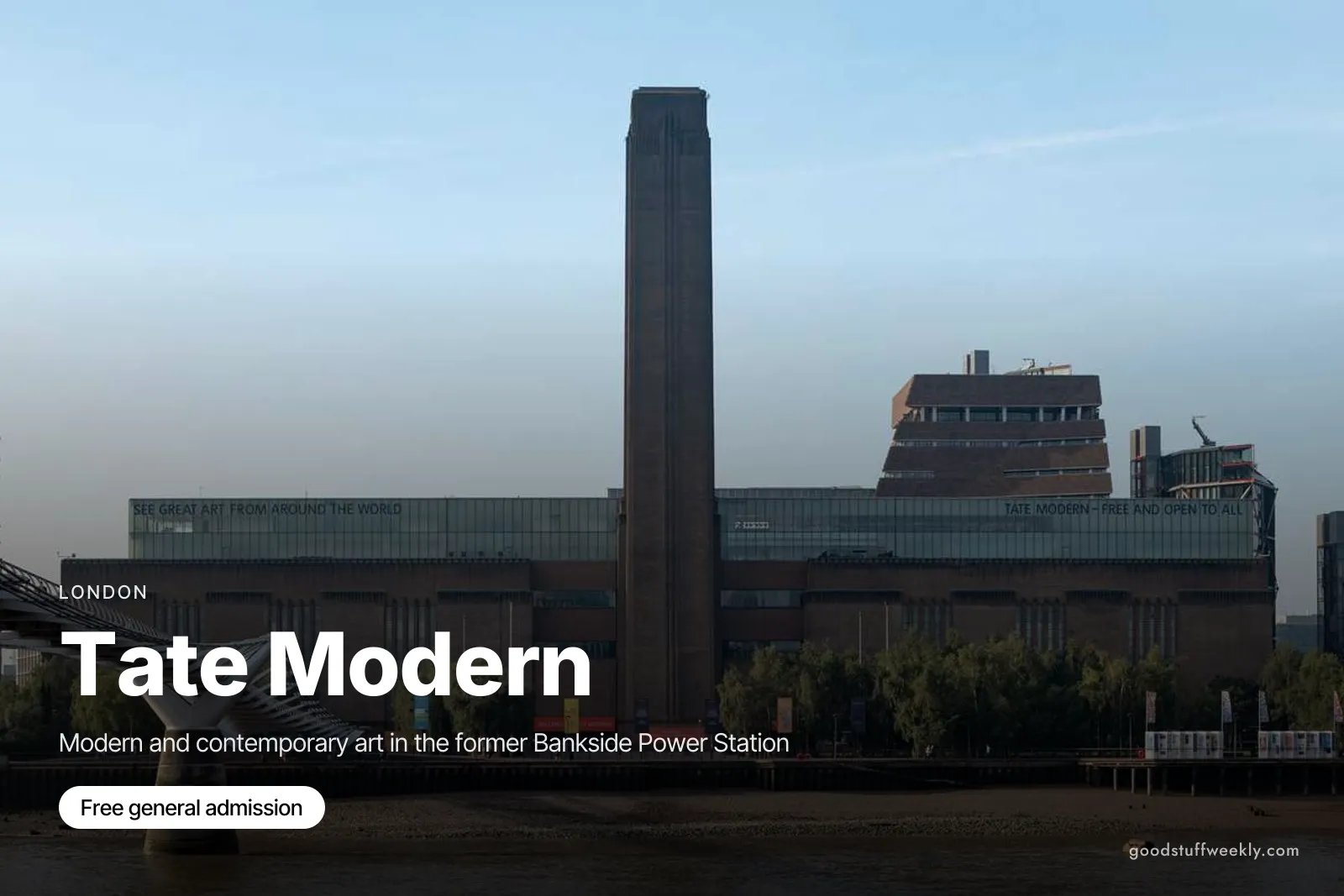
Tate Modern is London’s free gallery of international modern and contemporary art, set in the former Bankside Power Station with its vast Turbine Hall.
Tate Modern: A Power Station That Became a Cathedral for Contemporary Art
Approach along the Thames from the Millennium Bridge and the building stops you before you reach the door: a colossal brick hulk with a single square chimney, once the Bankside Power Station and now the UK's most popular art gallery. In 2025 it drew about 4.5 million visitors, and admission to the collection displays is free.
Tate Modern collects international modern and contemporary art from around 1900 to the present. Its rooms are arranged by theme and idea rather than as a straight timeline, which makes the walk through its floors feel more like a conversation between artists than a lecture.
About the Museum
Sir Giles Gilbert Scott, who also designed the classic red telephone box and Battersea Power Station, drew up Bankside Power Station in two phases between 1947 and 1963. It generated electricity for London until oil prices and pollution concerns closed it in 1981, leaving a vast, empty shell on the South Bank.
In the 1990s Tate chose the derelict building as the home for its international modern collection. Swiss architects Herzog & de Meuron won the competition, and their £134 million conversion kept the character of the original structure: the brick exterior, the chimney and the immense Turbine Hall. Queen Elizabeth II opened it on 11 May 2000. Its first-year attendance reached 5.25 million visitors, more than double what Tate's three existing galleries had drawn together the previous year.
The second phase came in June 2016, when a ten-storey extension rose behind the old power station. Formerly called the Switch House and renamed the Blavatnik Building in 2017, it added roughly 22,500 square metres of gallery and public space. The project also turned three underground oil tanks into performance and film spaces called The Tanks.
The Collection
Tate Modern shows international modern and contemporary art from around 1900 onward, drawn from the wider Tate collection. Its displays cover painting, sculpture, installation, photography, film, performance and works on paper, with an emphasis on artists from across the globe.
Rooms are organised by theme and idea rather than a strict timeline, and displays are refreshed regularly. Large commissions in the Turbine Hall and temporary exhibitions in the paid galleries add to the permanent presentation.
What Can You Explore?
The building holds a wide range of art, and while displays change regularly, some anchors stay put.
- Picasso, Matisse, Dalí and the early modernists. Cubism, Fauvism and Surrealism are traced through key works and groupings.
- Mark Rothko's Seagram Murals. Paintings made in the late 1950s for a New York restaurant that the artist withdrew, they were donated to Tate in 1970 and have a dedicated, dimly lit room where many visitors sit in silence.
- Pop and postwar art. Andy Warhol, Roy Lichtenstein and Francis Bacon appear alongside Louise Bourgeois and Joseph Beuys.
- Conceptual and performance art. Video, installation and works on paper trace how artists challenged what a painting or sculpture could be.
- Global contemporary art. Artists from Africa, Asia, Latin America and the Middle East are increasingly at the centre of the displays, not the margins. Yayoi Kusama's mirrored rooms and Yoko Ono's participatory works appear in different programmes.
- Photography, film and media. Photographers and filmmakers are integral to the collection, with dedicated spaces for screenings and installations.
Special exhibitions, which are ticketed, give major artists a full retrospective. Recent blockbuster shows have focused on artists such as Frida Kahlo, Yayoi Kusama and Olafur Eliasson.
The Turbine Hall
At roughly 3,400 square metres and six storeys tall, the Turbine Hall is the building's spectacular void. It started life housing the power station's generators, and now it hosts a commission each year that responds to its scale.
Among its most memorable installations were Louise Bourgeois's giant spiders at the gallery's opening in 2000, Anish Kapoor's trumpet-shaped Marsyas in 2002, Olafur Eliasson's glowing The Weather Project in 2003, Carsten Höller's slides in 2006, Doris Salcedo's crack in the floor, Shibboleth, in 2007, and Ai Weiwei's millions of porcelain Sunflower Seeds in 2010. The commissions are currently sponsored by Hyundai.
Museum Architecture & History
Herzog & de Meuron's approach was subtle. They left much of the old building's raw texture in place, adding a glazed lightbeam along the roof and a new entrance. The Blavatnik Building's twisted pyramidal shape, wrapped in perforated brick, creates a striking silhouette that changes with the light.
At the top, the Blavatnik Building's free viewing level gives 360-degree views across London, from St Paul's Cathedral to the towers of the City and the Shard. It is one of the best free viewpoints in the capital, and it is at its most atmospheric near sunset.
Online Collections & Research
Tate's website features audio guides, artist interviews and articles on the works on display, and the Tate Modern collection can be browsed online. The gallery runs talks, screenings and workshops for adults, families and schools, and a research centre supports scholars working in modern and contemporary art.
Visitor Experience
The gallery is big enough to tire even fit visitors, so it helps to choose a route. A quick highlights tour of Rothko, Picasso, Warhol and the Turbine Hall takes about two hours; a thorough visit including a special exhibition can fill a full day.
- Try the Blavatnik entrance. The Park Street entrance often has shorter waits than the riverside Turbine Hall entrance, especially on Saturday afternoons.
- Visit later in the day. Friday and Saturday evening opening brings a calmer, more atmospheric feel.
- Give the Tanks a look. These unusual spaces host live art and film programmes.
- Take the viewing level in the evening. The city lights and the illuminated Thames make it worth the queue.
- Look for the small rooms. Sometimes the most rewarding displays are the intimate ones tucked beside the big-name galleries.
Planning Your Time
A two-hour route through Tate Modern can begin in the Turbine Hall, where the current commission sets the mood. Take the escalators to the Blavatnik Building and start with the highest collection floors, then work down through the Rothko room, the Picasso and Matisse galleries and the room of pop art. Finish in the Tanks if a live programme is on. If you still have energy, ride to the tenth-floor viewing level at sunset, when the city lights begin to appear.
The Blavatnik entrance on Park Street usually has the shortest queue, especially on Saturday afternoons. On Friday and Saturday nights, when the gallery stays open until 10:00 pm, the rooms are calmer and the building glows. Mornings on weekdays are the quietest time for the paid exhibitions, which should be booked in advance. In summer, the terrace and riverside are pleasant, and in winter the warm galleries are a welcome refuge from the Thames wind.
Visit
Tate Modern is open from Sunday to Thursday, 10:00 am to 6:00 pm, and Friday and Saturday, 10:00 am to 10:00 pm. The last entry is around 30 minutes before closing. Hours can change for special events and holidays, so check the website before travelling.
Tickets
Entry to the collection displays is free, and you can generally drop in without booking. Charges apply for special exhibitions, and prices vary by show; booking ahead is recommended for popular ones. Tate members enjoy free entry to exhibitions and other perks.
Getting There
The gallery sits on Bankside on the south side of the Thames.
- Underground: Southwark (Jubilee line) is about a 5-minute walk, and Blackfriars (Circle, District and National Rail) is similar.
- Rail: London Bridge and Waterloo are within a 15-minute walk.
- On foot: From St Paul's Cathedral, cross the Millennium Bridge and you arrive at the door.
- River bus: Thames Clippers services stop at Bankside Pier, next to the gallery.
Accessibility & Visitor Services
The building is step-free, with lifts to all floors and ramps at the main entrances, and wheelchairs can be borrowed at the information desks. The Turbine Hall's long slope can be a workout, but seating is placed along its length. Quiet spaces and accessible toilets appear on every floor. Bags and coats can be left in cloakrooms, and staff are on hand in the galleries to explain the displays in plain language.
Who Is It For?
- Art and design students who want a close look at twentieth- and twenty-first-century movements.
- Photographers and filmmakers, who find work by peers in dedicated displays.
- First-time visitors to London who want something dramatic that does not cost anything.
- Families, since the Turbine Hall and the interactive family programmes usually engage children.
Things to Know
- Two main entrances: The Turbine Hall entrance is grander, while the Park Street entrance is faster at busy times.
- Free galleries, paid exhibitions: Collection displays are free, but blockbuster shows need a ticket and often sell out.
- The Rothko room: It is dimly lit, and staff ask for quiet so that people can sit and look.
- Viewing level etiquette: The public terrace overlooks nearby flats, and visitors are asked to be considerate of residents.
- Displays change: Collection rooms are rehung regularly, so a favourite work may be elsewhere or on loan.
- Late nights: Friday and Saturday evenings offer extra hours and a livelier atmosphere.
Explore Tate Modern
Tate Modern rewards curious visitors who let themselves wander. Start with the Turbine Hall, choose a few themes that interest you and reserve time for the viewing level at the end. Check the website for the latest exhibitions, opening hours and events.
Visit the Tate Modern
For current opening hours, tickets, accessibility services and exhibitions, visit the official Tate Modern website before you travel.
Looking for more? Browse all museums on Good Stuff Weekly.
Last updated