State Russian Museum
The State Russian Museum in St. Petersburg holds the world’s largest collection of Russian art, from medieval icons to Malevich, in Carlo Rossi’s Mikhailovsky Palace.
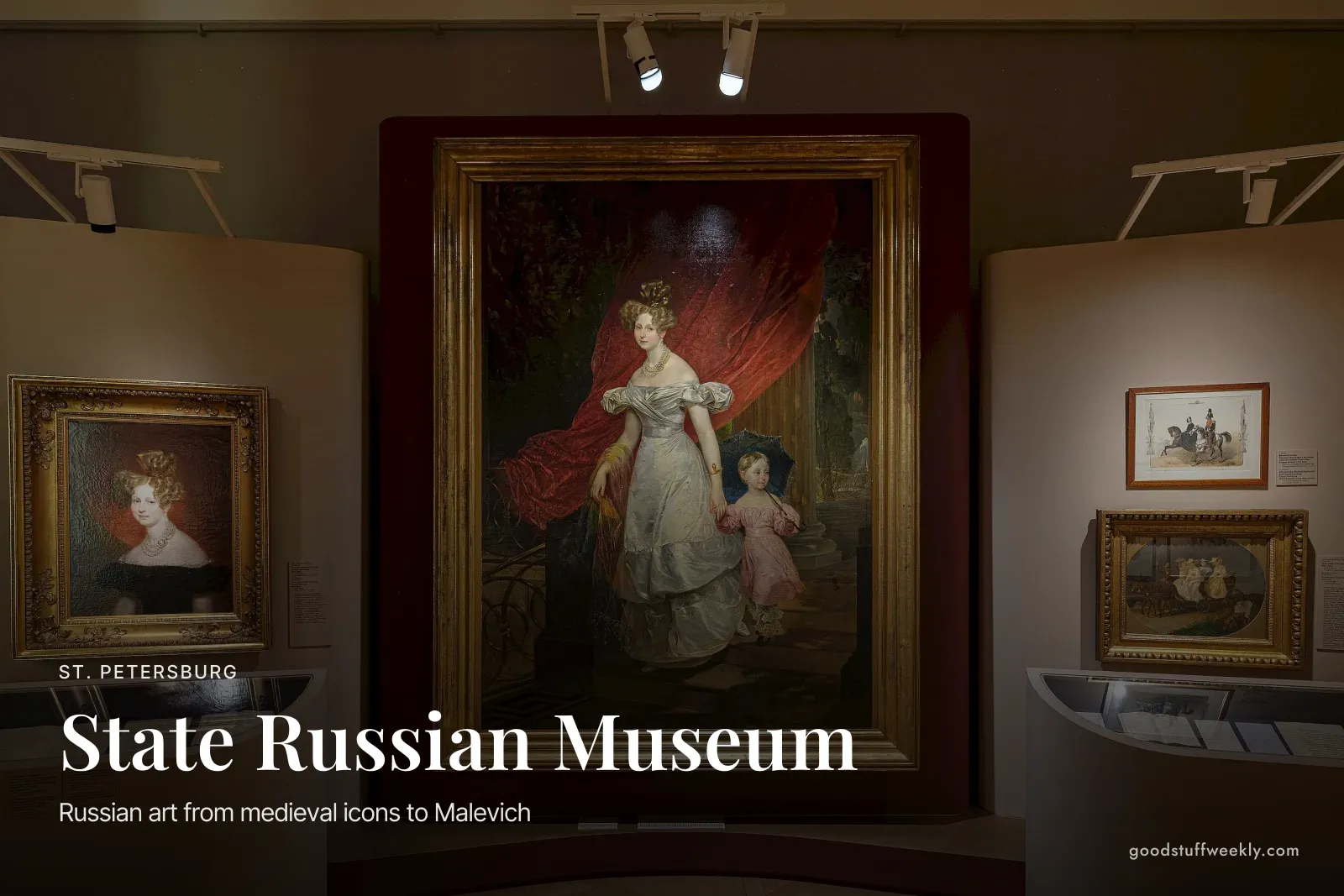
Russian Art From Icons to the Avant-Garde
To look at how Russia saw itself over a thousand years, you would struggle to find a better place than the Russian Museum. It is the world's largest collection devoted to Russian fine art, stretching from medieval icons of the tenth and eleventh centuries to the experiments of the twentieth and twenty-first. The setting suits it: a neoclassical palace a few minutes from Nevsky Prospect, behind a tidy green garden in the centre of St. Petersburg.
In 2022 the museum recorded about 2.65 million visitors, placing it high on the list of the world's most visited art museums. Even so, it tends to feel calmer than the Hermitage, and many travellers use it as the place to understand the painting, sculpture and craft traditions they have only glimpsed elsewhere.
About the Museum
The museum's home was built for a grand duke. Carlo Rossi designed the Mikhailovsky Palace between 1819 and 1825 for Grand Duke Mikhail Pavlovich, the youngest son of Emperor Paul I, and the ensemble of palace, garden and adjoining streets remains one of Rossi's best-preserved works. Its Ionic portico, ceremonial staircase and richly decorated halls survive largely intact.
After the grand duke's family died out, the palace passed to the state. In 1895 Emperor Nicholas II decreed the founding of a Russian national museum in memory of his father, Alexander III, and the collection opened to the public in 1898. Early holdings came from the Hermitage, the Academy of Arts and the imperial palaces, and after 1917 they multiplied through nationalisations and new acquisitions, giving the museum its extraordinary depth in the Soviet and avant-garde periods.
Today the Russian Museum is more than a single building. It manages the Mikhailovsky Palace and the adjoining Benois Wing, the Stroganov Palace, the Marble Palace, St. Michael's (Engineers') Castle and the Summer Palace of Peter I with its garden, together covering more than thirty hectares. In 2015 it also opened an overseas branch in a converted tobacco factory in Málaga, Spain.
The Collection
The State Russian Museum is the world's largest collection of Russian fine art, covering the tenth century to the present. Its holdings include icons, portraits, history painting, landscape, sculpture, graphic art, folk art and decorative arts, as well as an exceptional group of early twentieth-century avant-garde works.
The collection is shown across several historic buildings in St. Petersburg, with the Mikhailovsky Palace housing the main chronological display and the other palaces offering more specialised or temporary programmes.
What Can You Explore?
The main building presents a narrative line through the centuries. Here are the works that draw the most attention.
- Early icons. Panels from Novgorod, Pskov, Moscow and other centres, with luminous colour and stylised faces that shaped how Russians pictured the sacred. The oldest date from the twelfth century.
- Eighteenth-century portraiture. Rokotov, Levitsky and Borovikovsky portray courtiers and provincial gentry with warmth and subtle psychological detail.
- Karl Bryullov, The Last Day of Pompeii. A huge canvas from 1830–1833 that brought Russian painting to European attention. Its theatrical light and struggling crowd are best seen in person.
- Ivan Aivazovsky, The Ninth Wave. A stormy sea at sunrise, showing survivors clinging to wreckage. It is the best-known marine painting in the collection.
- Ilya Repin. Barge Haulers on the Volga is a landmark of social realism, while Reply of the Zaporozhian Cossacks is a raucous group scene painted over more than a decade.
- Vasily Surikov, Viktor Vasnetsov and Ivan Shishkin. Historical epics, fairy-tale imagery and pine-forest landscapes.
- Mikhail Vrubel, Valentin Serov and the Silver Age. Symbolist brooding, elegant portraits and Art Nouveau design.
- The avant-garde. Kazimir Malevich, Wassily Kandinsky, Marc Chagall, Pavel Filonov and others present the radical experiments that changed art in the early twentieth century, including Malevich's famous Black Square works.
- Folk art and decorative arts. Wood carving, textiles, porcelain and lacquer show how craft traditions ran parallel to the academy.
Museum Architecture & History
Rossi's palace is a lesson in imperial-period design. The main staircase, the White Hall, and the ceremonial rooms retain moulded ceilings and marble details, while the museum's later expansion, the Benois Wing, added a modernist counterpoint in the early twentieth century. Rooms flow from one to another, which means you can follow the collection chronologically without backtracking.
Behind the palace, the Mikhailovsky Garden is a peaceful place to sit between galleries. In summer, locals read on benches under old trees, and in winter the pond freezes over. The nearby Church of the Saviour on Spilled Blood and Nevsky Prospect are only a short walk away, so the museum slots easily into a wider day of sightseeing.
Online Collections & Research
The museum's English-language website offers virtual tours, digitised parts of the collection, and background on each palace. Scholars can request access to the museum's library and archive by appointment, and the institution publishes catalogues and research papers on Russian art history. Guide materials and audio guides are available for visitors who want to study before a visit.
Visitor Experience
The main collection in the Mikhailovsky Palace takes two to three hours if you follow the whole chronology and a comfortable half day if you add a second building. The Benois Wing, which hosts temporary exhibitions, often needs a separate ticket. Visitors with limited time may prefer to concentrate on the nineteenth and early twentieth centuries, where the museum's most famous canvases hang.
- Start on the first floor and work upward. The sequence tends to move from earlier centuries to the twentieth.
- Allow a break in the garden. The park makes a good rest stop before you go back for the avant-garde rooms.
- Combine buildings by theme. The Stroganov Palace has restored interiors, and the Marble Palace hosts foreign art from the Ludwig collection, so pick according to your interests.
- Bring your passport if you buy a discounted ticket. Reduced rates require proof of eligibility.
Planning Your Time
To see the Russian Museum's story in order, begin on the first floor with the icons and eighteenth-century portraits, then follow the rooms upstairs to the nineteenth century, where Bryullov's Last Day of Pompeii and Aivazovsky's Ninth Wave hang. Spend the middle of your visit with Repin, Surikov and Shishkin, and finish with the Silver Age and the avant-garde. If you have time left, walk into the Benois Wing for a temporary exhibition and rest in the Mikhailovsky Garden before continuing.
Thursday evenings, when the main building opens at 1:00 pm and stays until 9:00 pm, are quieter than the busy morning hours on weekends. White Nights in June turn the garden into a lively public space, while the darkest winter months leave the galleries almost empty. Because the museum manages several palaces, decide which one suits your interest before you buy a ticket, and remember that each has its own hours and closing day.
Visit
The Mikhailovsky Palace is generally open on Monday, Wednesday, Friday, Saturday and Sunday from 10:00 am to 6:00 pm, on Thursday from 1:00 pm to 9:00 pm, and closed on Tuesday. Other buildings keep different schedules, so check the museum's website for the one you intend to visit.
Tickets
Ticket rates differ between Russian and EAEU citizens and other visitors. Recent listings put the adult ticket for foreign visitors at around 1,000 rubles on weekdays for the main building, and a combined ticket for permanent exhibitions across all the museum's palaces at about 2,100 rubles. Temporary exhibitions are separate. Payment options and card acceptance for foreign visitors can change, so confirm before you travel and carry enough cash if needed.
Getting There
The Mikhailovsky Palace faces Arts Square, which is in the heart of the historic centre.
- Metro: Nevsky Prospect (Line 2) and Gostiny Dvor (Line 3) are the closest stations, each about 5 to 10 minutes on foot.
- On foot: From Nevsky Prospect, walk along the Griboedov Canal embankment to the Church of the Saviour on Spilled Blood, then turn into the Mikhailovsky Garden.
- Bus and trolleybus: Several lines run along Nevsky Prospect and stop nearby.
Accessibility & Visitor Services
The Mikhailovsky Palace has ramps and lifts serving most galleries, and cloakrooms operate on the ground floor. As with many historic Russian palaces, some staircases and thresholds cannot be avoided, so wheelchair users should ask staff about the current accessible route through the chronological display. Audio guides are available, and printed floor plans help visitors find the shortest path between the icons and the twentieth-century rooms.
Who Is It For?
- Art history students who want to see the work of the Wanderers, the Silver Age and the avant-garde in one place.
- Travellers already visiting the Hermitage who want to understand Russian painting on its own terms.
- Designers and craftspeople, who will find icons, folk art, porcelain and textiles.
- Anyone curious about Russian history, since the paintings often depict key events and social scenes.
Things to Know
- Check each building's hours: The Mikhailovsky Palace, Stroganov Palace, Marble Palace and other sites have different schedules and closing days.
- Foreign visitor prices: Rates for non-citizens are higher than those for Russian and EAEU visitors, so confirm the current price before travelling.
- Payment can be tricky: Cards issued abroad may not work, so carry a payment method you have already tested.
- Photography is restricted: Flash is banned, and some rooms limit photography altogether.
- Cloakroom is compulsory: Coats, umbrellas and larger bags go to the ground-floor cloakroom before you enter the galleries.
- Labels are mostly Russian: English texts cover the main rooms, so an audio guide fills the gaps.
Explore the State Russian Museum
For a deep look at Russian creativity, the Russian Museum should be one of your first stops in St. Petersburg. Check the official website for opening days, current ticket options and exhibitions, and let the chronological route carry you from icons to the avant-garde.
Visit the State Russian Museum
For current opening hours, tickets, accessibility services and exhibitions, visit the official State Russian Museum website before you travel.
Looking for more? Browse all museums on Good Stuff Weekly.
Last updated