State Hermitage Museum
The State Hermitage Museum in St. Petersburg holds over three million works in the Winter Palace and its neighbours, from Leonardo and Rembrandt to the Peacock Clock.
Six Buildings, Three Million Objects and an Empress's Private Retreat
The Hermitage began as one woman's private pleasure and grew into one of the largest museums on earth. Walk into the green-and-white Winter Palace from Palace Square and you enter a chain of state rooms, galleries and courtyards that stretches along the Neva River for hundreds of metres. It holds more than three million items, from Egyptian mummies and Scythian gold to Impressionist canvases and Fabergé jewels, and the building surrounding them is as much an exhibit as the art.
It draws millions of visitors a year, about 2.8 million in 2022, and it rewards those who arrive with a plan. Nobody sees the whole thing; anyone who tried to spend a minute in front of each item would need years. The best visits choose a few halls, linger, and leave room for the palace itself.
About the Museum
The story begins in 1764. Empress Catherine the Great bought a collection of about 225 paintings from a Berlin merchant, Johann Ernst Gotzkowsky, which he could not deliver to Frederick the Great. She stored the works in a private wing next to the Winter Palace, and the wing became known as the Hermitage, from the French word for a place of retreat. Only Catherine and her closest guests were allowed in.
She kept collecting, buying whole libraries and picture galleries from European aristocrats and commissioning new buildings to house them. The Small Hermitage came first, followed by the Old Hermitage and the Hermitage Theatre. Later tsars expanded the holdings further, and in 1852 Nicholas I opened the New Hermitage, designed by Leo von Klenze, as a public museum. For the first time, ordinary people who applied for access could enter.
After the 1917 revolution the Winter Palace became part of the museum, and nationalised private collections poured in. The State Hermitage today occupies six historic buildings, including the Winter Palace, the Small, Old and New Hermitages, the Hermitage Theatre and the eastern wing of the General Staff Building across the square.
The Collection
The Hermitage houses more than three million objects, and it is often described as home to the largest collection of paintings in the world. Its holdings run from the Stone Age to the twentieth century and cover most cultures that produced art, including Egyptian, Greek, Roman, Byzantine, Russian, Western European, Middle Eastern and Central Asian.
The core is European painting and sculpture, but archaeology, coins, jewellery, arms and armour, decorative arts and applied art are just as important. Some sections were shaped by unusual events, such as the Scythian gold that came out of Siberian burial mounds or the great French collections of Impressionist art assembled by Moscow merchants before the revolution.
What Can You Explore?
Given the scale, it helps to think in themes.
- Italian Renaissance. Leonardo da Vinci's Benois Madonna and Litta Madonna and works by Raphael, Titian and Michelangelo (his Crouching Boy sculpture) are among the great treasures. They are gathered in the Old and New Hermitage.
- Dutch and Flemish painting. Rembrandt's late masterpiece The Return of the Prodigal Son and Danaë hang here, alongside Rubens, Van Dyck and Frans Hals. The Rembrandt room is a highlight for many visitors.
- Spanish painting. El Greco, Velázquez, Murillo and Goya are shown in the New Hermitage.
- Impressionism and modern art. Monet, Renoir, Cézanne, Van Gogh, Gauguin, Matisse and Picasso fill the General Staff Building and upper galleries. Matisse's The Dance is one of the most photographed paintings in the collection.
- The Peacock Clock. An eighteenth-century mechanical marvel of gilded bronze birds and a mushroom that opens and closes, brought to Russia by Prince Potemkin as a gift to Catherine the Great. Demonstrations are staged on certain days.
- Egyptian and classical antiquities. Mummies, sarcophagi and marble sculpture, including the Roman statues in the Hall of the Twenty Columns.
- Scythian gold and Central Asian art. Jewellery and ornaments buried with steppe warriors thousands of years ago.
- The state rooms of the Winter Palace. The Jordan Staircase, the Malachite Room, the Armorial Hall and the Gallery of 1812 show how the imperial court lived and celebrated.
- Cats. The museum's resident cats are a much-loved tradition, and they patrol the cellars to keep mice away from the collection.
Museum Architecture & History
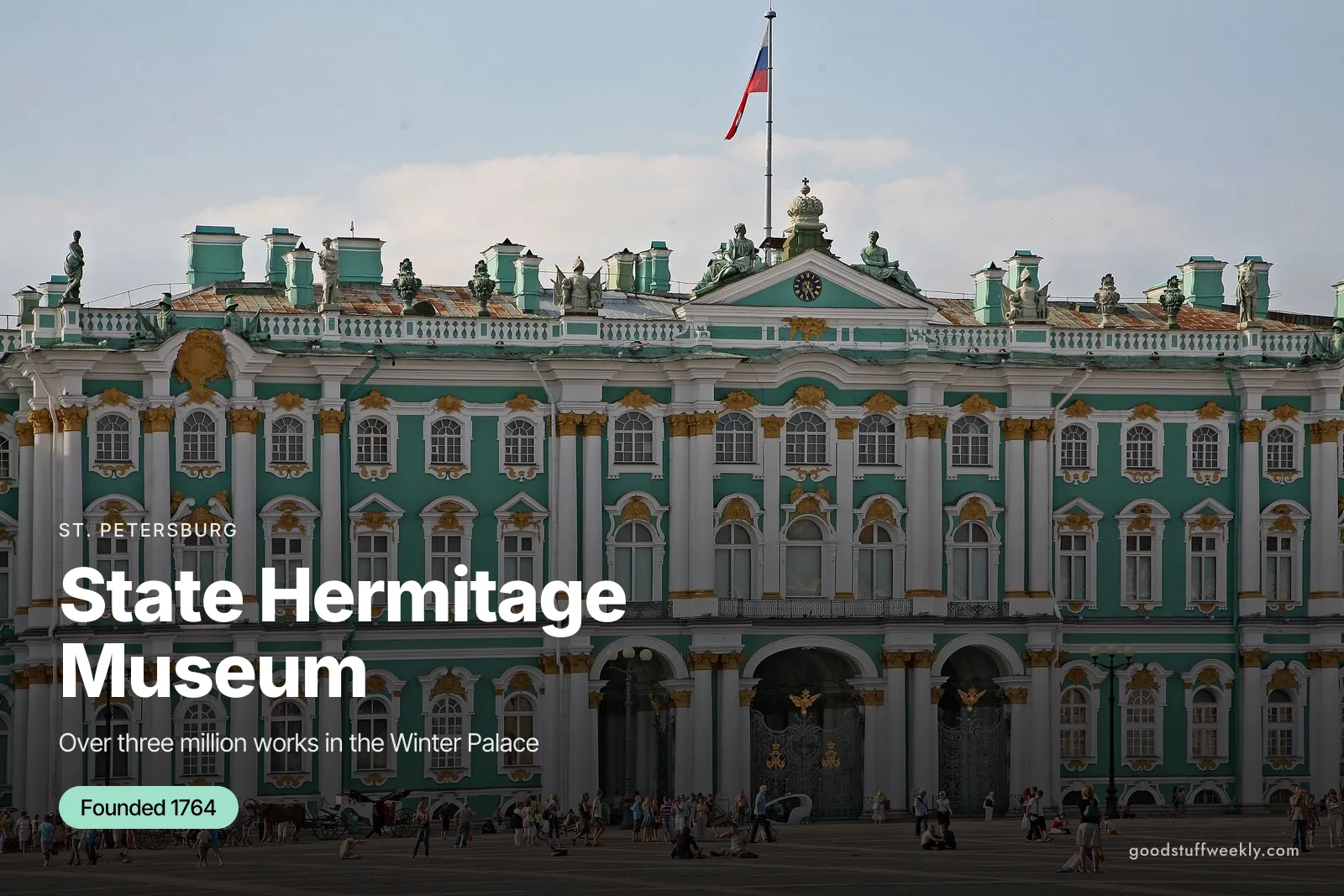
The Winter Palace itself is a masterpiece of Russian Baroque, designed by Francesco Bartolomeo Rastrelli for Empress Elizabeth and completed in 1762. Its long green façade, decorated with white columns and statues along the roofline, looks out over Palace Square, the scene of the historical events of 1905 and 1917. The palace was rebuilt after a serious fire in 1837, and many interiors date from the reconstruction.
The Jordan Staircase, white and gold under a painted ceiling, is the palace's ceremonial entrance to the state rooms. The Malachite Room, with columns and vases in polished green stone, was created for Empress Alexandra Fyodorovna. In the New Hermitage, the Klenze-designed atlantes, ten large granite figures at the entrance, greet visitors.
The General Staff Building across the square, with its huge triumphal arch, was converted to exhibit later art, and its modernist galleries offer a contrast to the imperial gilding. The whole complex is now a UNESCO World Heritage Site as part of the Historic Centre of Saint Petersburg.
Online Collections & Research
The Hermitage runs a multilingual website with a searchable online catalogue, virtual tours of selected halls, and digital projects and lectures. It has one of the largest research libraries in Russia and publishes scholarly catalogues and papers. The museum's archaeological expeditions and conservation laboratories are also active, and their work is featured in exhibitions and online articles.
Visitor Experience
A whole day inside the museum is realistic and still only skims the surface. Many visitors split it into two visits or buy a two-day ticket. A focused route might take in the Jordan Staircase, the Italian Renaissance rooms, the Rembrandt room, the Impressionist galleries and the Peacock Clock, which fills roughly four to five hours.
- Arrive at opening. Queues at the entrance grow quickly by late morning, especially in summer.
- Start with the Winter Palace state rooms. They are magnificent when quiet, and the crowds are thinner early on.
- Wear comfortable shoes. The route can exceed several kilometres, and floors are hard.
- Take a break. There are cafés in the courtyard and inside several buildings, and benches in the larger halls.
- Use the Wednesday and Friday evenings. Later closing times give a calmer atmosphere and a chance to see the halls after tour groups leave.
Planning Your Time
The Hermitage is best treated as several visits folded into one. For a first day, enter through the ticket courtyard, climb the Jordan Staircase and follow the state rooms toward the Peacock Clock in the Pavilion Hall, then continue to the Leonardo and Raphael rooms in the Old Hermitage. Break for lunch in one of the museum's cafés before crossing to the General Staff Building, where the Impressionists and Matisse's The Dance fill the upper floors. Even a full day will show you only a small part of the collection, so decide which two or three sections matter most.
Wednesday and Friday evenings run until 9:00 pm, and winter weekday mornings are the quietest of all, though the palace rooms can be chilly. Summer, particularly the White Nights in June, brings the biggest crowds. A two-day ticket lets you split the collection sensibly, with the Winter Palace on one day and the General Staff Building on the other.
Visit
- Tuesday, Thursday, Saturday and Sunday: 10:30 am – 6:00 pm
- Wednesday and Friday: 10:30 am – 9:00 pm
- Monday: Closed
The museum is also closed on 1 January and 9 May. Ticket offices close about an hour before the museum, and hours can change, so confirm them on the official website before you travel.
Tickets
Foreign visitors currently pay about 1,000 rubles for a standard adult ticket, while Russian citizens and students with valid ID pay less. A two-day ticket costs about 1,500 rubles and allows re-entry within 48 hours. Admission is free for children and students on certain terms, and there is a free-entry day on the third Thursday of each month for some categories of visitors. Prices differ between sources, so check the official website. Buy in advance if you can, since the main ticket hall can have long queues.
Payment options for foreign visitors may be limited, and cards issued outside Russia may not always work, so confirm what is accepted before travelling.
Getting There
The main entrance faces Palace Square in the historic centre of the city.
- Metro: Admiralteyskaya station (Line 5) is the closest, about a 10-minute walk. Nevsky Prospect (Line 2) and Gostiny Dvor (Line 3) are also nearby.
- Bus and trolleybus: Several routes run along Nevsky Prospect and stop near Palace Square.
- On foot: From Nevsky Prospect, walk through the Alexander Column square to reach the main gate.
- Ticket office: It is inside the courtyard, reached through one of the arches from Palace Square.
Accessibility & Visitor Services
The Winter Palace is a historic building, so not every room is equally easy to reach. Step-free routes and lifts serve the main visitor circuit, but a few state rooms and older staircases still require assistance. Ask at the ticket courtyard about the recommended wheelchair route, and consider a guided tour, since the guides know which corridors to take. Wheelchairs and benches are available, though seating between the major rooms is limited. Allow more time than you expect for the long distances between the Winter Palace and the General Staff Building.
Who Is It For?
- Art and art history students, who can study the development of European painting in one place.
- Designers and craftspeople, who will find jewellery, gilded interiors, tapestries and decorative art.
- History and archaeology enthusiasts, thanks to the Egyptian, Scythian and Classical collections.
- Travellers to St. Petersburg who want to experience the imperial city from the inside.
- Architecture lovers, drawn to Rastrelli's Baroque and Klenze's classical halls.
Things to Know
- Two-day ticket: The two-day pass is the practical option for anyone hoping to see both the main palace and the modern art building.
- Payment can be tricky: Foreign-issued bank cards have been unreliable at Russian venues, so check current payment options and carry a backup.
- Cloakroom is compulsory: Coats, large bags and umbrellas go to the cloakroom, and the queue at the end of the day can be long.
- Photography: Photography without flash is usually allowed, though some temporary exhibitions and rooms are exceptions.
- Follow the arrows: The museum has numbered rooms and marked routes, and a paper plan helps in the Winter Palace.
- Check travel advisories: Government travel guidance for Russia changes, so review it before you plan a trip.
Explore the State Hermitage Museum
The Hermitage repays curiosity and planning in equal measure. Pick your themes, arrive early, and let the palace itself be part of the story you take home.
Visit the State Hermitage Museum
For current opening hours, tickets, accessibility services and exhibitions, visit the official State Hermitage Museum website before you travel.
Looking for more? Browse all museums on Good Stuff Weekly.
Last updated