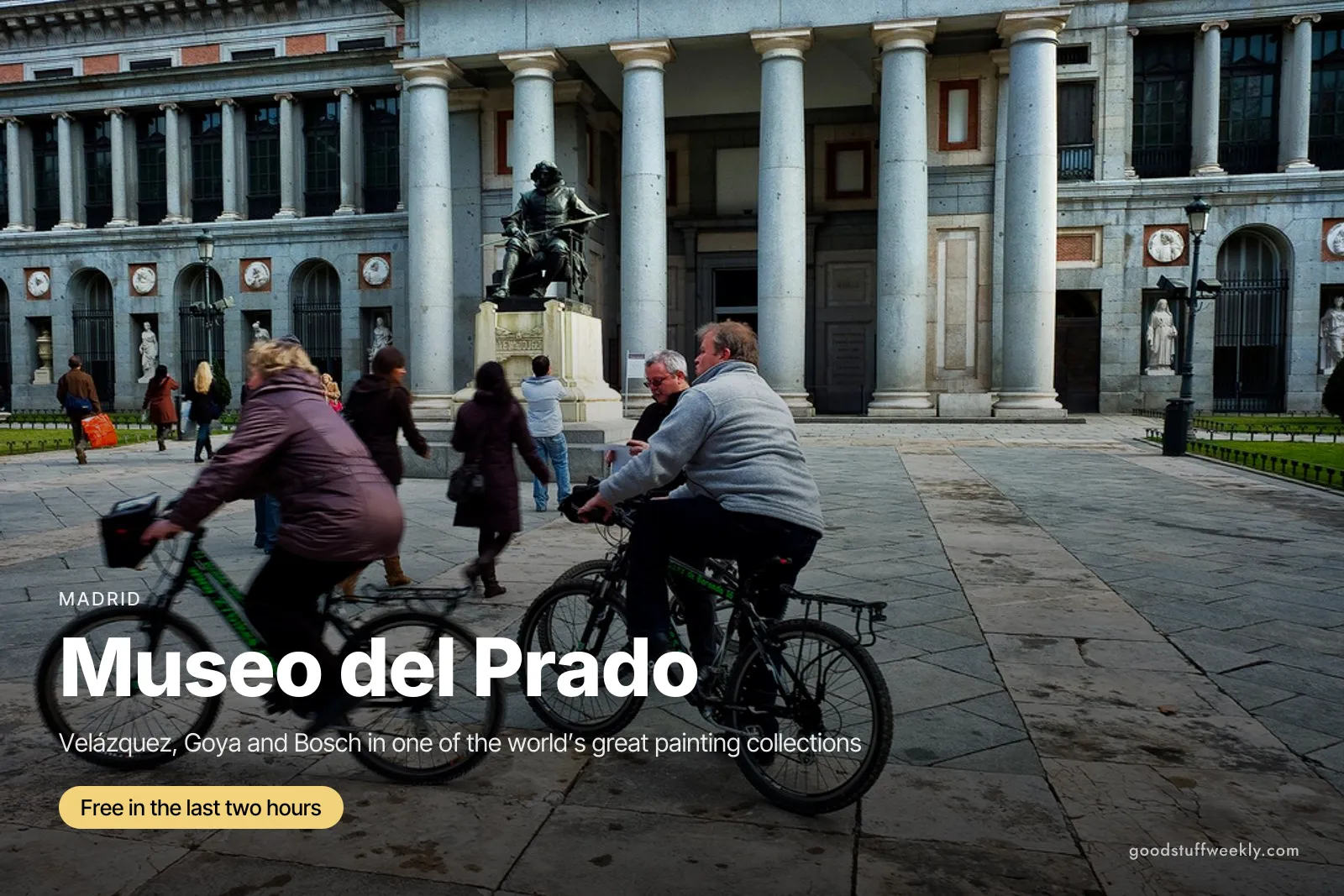
Museo del Prado
The Museo del Prado in Madrid holds one of the world’s great painting collections, with Velázquez’s Las Meninas, Goya’s Black Paintings and Bosch’s Garden of Earthly Delights.
Where Spain's Royal Painters Meet the World's Great Masters
There are museums that give a broad overview, and there are museums that hand you a lasting view of one country's imagination. The Prado in Madrid is the second kind. Walk through its central galleries and you pass from Velázquez's court portraits to Goya's nightmares, taking in El Greco's elongated saints, Titian's sensuous myths and Bosch's crowded visions on the way. It is the reason Madrid is considered one of Europe's capitals of painting.
The Prado is comparatively compact, with about 1,300 works on display at any time out of a much larger holding, and that scale makes it possible to leave with a clear memory of what you saw. About 3.3 million visits were recorded in 2023, a figure that puts it among the most visited art museums in the world.
About the Museum
The building predates the museum. In 1785, King Charles III commissioned the architect Juan de Villanueva to design a neoclassical home for the Cabinet of Natural Sciences, part of a scheme to turn the Paseo del Prado into a boulevard of science and culture. The building was still unfinished when Napoleon's troops occupied Madrid in 1808, and they used it as a barracks and stable, causing damage.
The idea of a museum came afterwards. King Ferdinand VII, encouraged by his wife, Queen Maria Isabel of Braganza, decided to open the building as a Royal Museum of Paintings and Sculptures. It opened in November 1819, with about 300 paintings from the Spanish royal collection, which had been assembled by generations of Habsburg and Bourbon rulers who were obsessive art patrons.
Over the next two centuries the museum expanded through royal transfers, acquisitions and donations, and from the twentieth century it became a national institution. In 2007, the Spanish architect Rafael Moneo completed a major extension that added about 16,000 square metres, including a modern cloister built around the restored Jerónimos cloister.
The Collection
The Prado's holdings include about 7,600 paintings, more than 8,000 drawings, nearly 5,000 prints and around 1,000 sculptures, plus decorative arts and other objects. It is the world's foremost collection of Spanish painting from the twelfth to the early nineteenth century, and also one of the best places to see Flemish, Italian and Dutch art of the Renaissance and Baroque.
The strength of the collection reflects royal taste. The Spanish crown was among the greatest patrons of Titian, Rubens, Velázquez and Goya, and many of their paintings entered the collection directly from the palace walls. As a result, the Prado shows not just individual masterpieces but the relationships between artists and the rulers who employed them.
What Can You Explore?
A route through the Prado is essentially a route through Spanish and European painting. These are the works that draw the biggest crowds.
- Diego Velázquez. Las Meninas (1656), the complex portrait of the infanta and her attendants with the painter himself at the easel, is regarded as one of the most analysed paintings in history. Nearby, The Surrender of Breda and The Spinners show his range. Room 12 is the centre of the display.
- Francisco de Goya. The enormous canvas The Third of May 1808 records the execution of Spanish rebels by French troops, while The Second of May and the tender The Parasol show other sides of his career. The Black Paintings, the murals Goya made late in life on the walls of his own house, including Saturn Devouring His Son, are among the most unsettling works of the collection.
- Hieronymus Bosch. The Garden of Earthly Delights (c. 1490–1500), a triptych of paradise, pleasure and hell, holds visitors for long minutes in front of its tiny scenes.
- El Greco. Elongated figures and flame-like brushwork in paintings such as The Nobleman with His Hand on His Chest.
- Titian. Charles V at Mühlberg and mythological poesie painted for Philip II, considered the foundation of European court portraiture.
- Rubens, Rembrandt and Dürer. The Prado's Flemish and Northern collections include Rubens's The Three Graces and Dürer's self-portrait of 1498.
- Fra Angelico and Raphael. The Annunciation and The Holy Family are among the museum's Italian treasures.
- Murillo and Zurbarán. Devotional painting of Seville's Golden Age.
- Sculpture and drawings. Rotating displays of works on paper, and classical and Renaissance sculpture, add depth.
Museum Architecture & History
Villanueva's building is a fine example of Spanish neoclassicism, with a long façade broken up by porticos, columns and pediments, and a central entrance framed by a pavilion. Its original galleries, lit from above, are the most beautiful spaces in the museum, and a visit to the Velázquez rooms is as much about the light as the paintings.
Moneo's extension, completed in 2007, joined the old building to the cloister of the Church of Los Jerónimos, a sixteenth-century monastery church that stands just behind the museum. The result is a quiet, modern set of galleries with the medieval cloister, dismantled and reassembled stone by stone, at their centre. Further projects, including the Hall of Realms, a former royal palace room converted into additional galleries under the Foster + Partners design, have extended the museum's reach along the Paseo del Prado.
Online Collections & Research
The museum's website offers a full online catalogue of its holdings, with high-quality photographs and detailed descriptions in Spanish and English, and virtual exhibitions on themes ranging from technical studies to individual artists. The Prado also runs a research centre, a library and an active restoration programme, and its scholars publish frequently on questions of authorship and technique. Educational resources and podcasts help visitors prepare before they come.
Visitor Experience
A well-planned visit takes two to three hours. Many people focus on the ground and first floor of the main building, where the famous works are grouped.
- Choose your top five. Velázquez, Goya, Bosch, El Greco and Titian make a sturdy shortlist.
- Enter through the side doors. The Goya entrance and the Jerónimos entrance are often quicker than the Velázquez door.
- Try the free hours with care. Evening free-admission slots are popular, and queues begin long before the doors open.
- Follow the numbered rooms. The museum's room numbers are a reliable guide to the most important works.
- Enjoy the neighbourhood. The Retiro Park and the Reina Sofía and Thyssen museums are nearby, in what Madrid calls the Golden Triangle of Art.
Planning Your Time
Because the Prado is dense with famous works, a focused route is more satisfying than wandering. Begin in the Goya galleries on the ground floor, then head to Velázquez in Room 12, where Las Meninas rewards a long look. Continue to the Bosch triptych, and finish with the Rubens and Titian rooms before the doors close. Leave the free evening slot for the Black Paintings if you prefer a quieter approach, but expect a crowd at the door before it starts.
Weekday mornings after 10:00 am are the quietest paid slots. The free evening hours, from 6:00 pm on weekdays and 5:00 pm on Sundays, are packed, and queues can form an hour before. Spring and autumn are the most comfortable seasons in Madrid, while the hot summer months push many visitors indoors. Two to three hours will cover the highlights, and the museum's shop and café are on the ground floor if you need a break.
Visit
- Monday to Saturday: 10:00 am – 8:00 pm
- Sundays and public holidays: 10:00 am – 7:00 pm
- Last entry: 30 minutes before closing
The museum is typically closed on 1 January, 1 May and 25 December, and it has shorter hours on 6 January, 24 December and 31 December. Confirm times on the official website before your visit.
Tickets
The standard ticket costs about €15. Admission is free for everyone from 6:00 pm to 8:00 pm, Monday to Saturday, and from 5:00 pm to 7:00 pm on Sundays and public holidays. Visitors under 18, students aged 18 to 25 with valid ID, and people with disabilities and their companions are admitted free. Booking a timed ticket online is recommended, and it is also possible to reserve a slot during free hours. Queues before the free period can start up to an hour or more in advance.
Getting There
The museum sits on the Paseo del Prado, in central Madrid.
- Metro: Banco de España (Line 2) and Estación del Arte (Line 1) are each about a 10-minute walk, and Atocha is also nearby.
- Rail: Atocha station is a 15-minute walk along the Paseo del Prado.
- Bus: Several lines stop at the Plaza de Cánovas del Castillo and the Paseo del Prado.
- On foot: From the Puerta del Sol, walk east through the Barrio de las Letras.
Accessibility & Visitor Services
The Prado's entrances at Jerónimos and Goya have ramps and lifts, and the galleries are mostly on level floors, with lifts between floors of the main building. Seating is available in many rooms, which is useful if you want to sit in front of a large painting. The museum offers tactile and audio-described programmes, and a quiet visit can be arranged in advance. Wheelchairs are loaned at the information desk, and priority entrances reduce waiting time.
Who Is It For?
- Painters and art students, who can study technique in the work of some of the great masters.
- Illustrators and designers, drawn to Bosch's imaginative detail and Goya's satire.
- History enthusiasts, thanks to the royal patronage behind the collection.
- Visitors to Madrid who want a museum that can be enjoyed in an afternoon.
- Anyone curious about Spanish culture, from the Golden Age to the Romantic era.
Things to Know
- Free hours are busy: The late free slots attract long queues, so a paid ticket at a quieter time is often more relaxing.
- Photography is banned: Photography is not allowed in the permanent galleries, so enjoy the paintings in person.
- Backpacks go to the cloakroom: Large bags and umbrellas must be left before entering the galleries.
- Follow the Room numbers: Room 12 for Las Meninas and Room 56A for Bosch are handy landmarks on the museum plan.
- Not all works are on show: Loans and restoration mean some paintings may be away, so check the website for a favourite.
- Combine with the Golden Triangle: The Reina Sofía and Thyssen-Bornemisza museums are within a short walk.
Explore the Museo del Prado
The Prado is a museum for slow looking. Book a ticket or choose the free-entry hours, decide on a handful of paintings, and give each the time it deserves. Check the museum's official website for opening hours, rules and current exhibitions.
Visit the Museo del Prado
For current opening hours, tickets, accessibility services and exhibitions, visit the official Museo del Prado website before you travel.
Looking for more? Browse all museums on Good Stuff Weekly.
Last updated