Musée d'Orsay
The Musée d’Orsay in Paris shows the world’s finest collection of Impressionist and Post-Impressionist art, from Monet and Degas to Van Gogh, in a former railway station.
A Railway Station That Now Holds the Sunlit Side of Nineteenth-Century Art
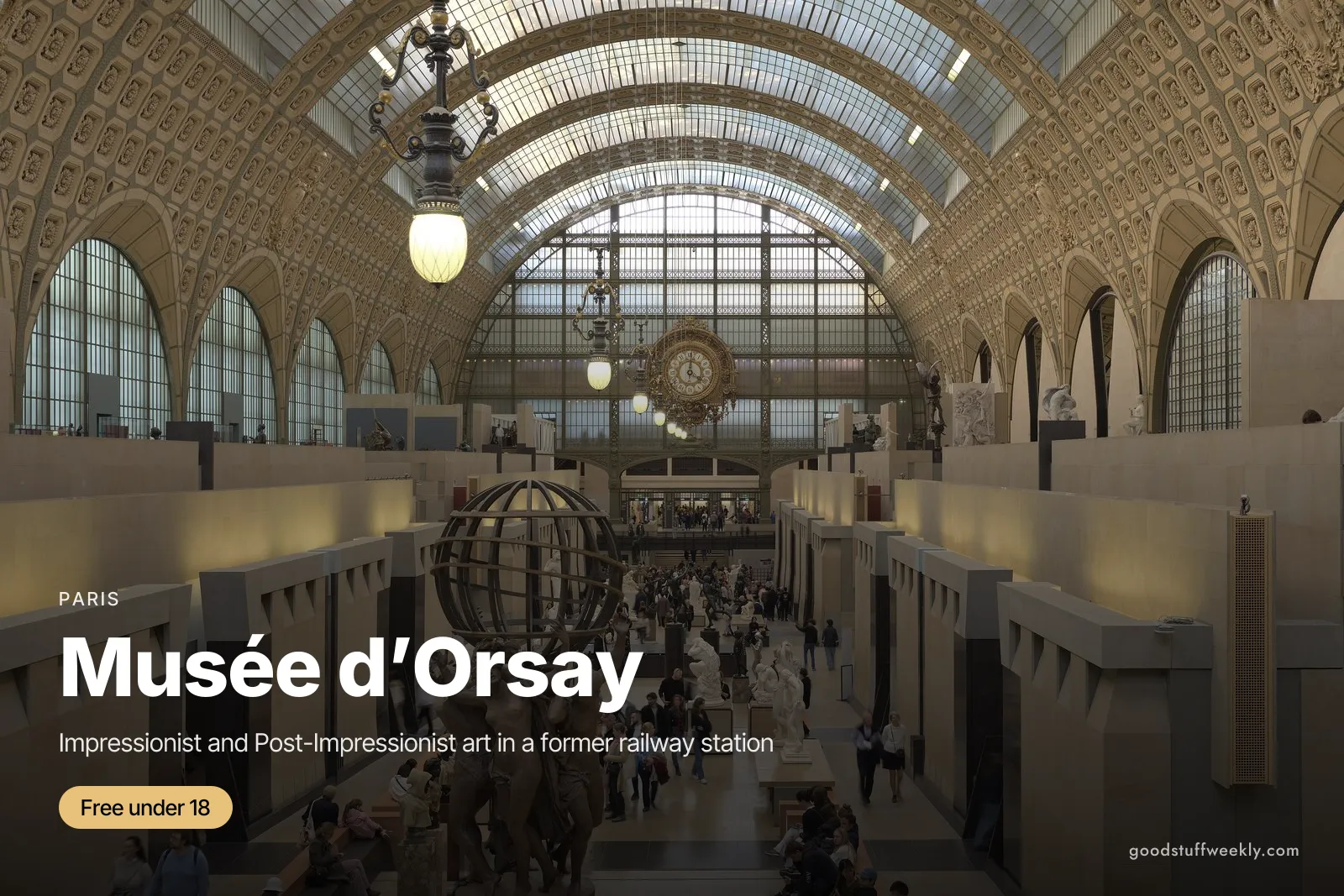
Paris has plenty of grand halls, but none quite like the one on the Left Bank of the Seine where steam locomotives once pulled in from the south-west. Under a curved glass-and-iron roof, where travellers used to queue for trains to Orléans, visitors now walk among sculptures and look down a nave that ends in a giant station clock. The Musée d'Orsay is the museum that made Impressionism its centrepiece, and it makes a strong case that the years between 1848 and 1914 were some of the most inventive in the history of European art.
Around 3.9 million visitors came in 2023, which put it among the most visited art museums on the planet. The scale is human, though. Compared with the Louvre across the river, the Orsay is a building you can walk in an afternoon, and it rewards people who prefer a single strong thread to a sprawling survey.
About the Museum
The building was born as the Gare d'Orsay, a station and hotel for the Paris–Orléans railway company. The architects Victor Laloux, Lucien Magne and Émile Bénard designed it in the grand Beaux-Arts style, and it opened just in time for the 1900 Exposition Universelle. Its metal structure was hidden behind a stone façade meant to blend with the neighbouring Palais de la Légion d'Honneur and the Louvre.
Progress in rail technology ended its first life quickly. By 1939, platforms were too short for modern electric trains, and long-distance services moved elsewhere. The station spent decades as a suburban terminal, a mailing centre, a film location and a set for productions such as Orson Welles's The Trial. In the 1970s a plan to demolish it and build a hotel was dropped, and the building received heritage protection in 1973.
The government then chose to turn it into a museum for art of the second half of the nineteenth century, a gap between the Louvre (works up to 1848) and the Musée National d'Art Moderne (from the early twentieth century). A design competition in 1978 was won by ACT Architecture, and the Italian designer Gae Aulenti created the interior layout in 1981. President François Mitterrand inaugurated the Musée d'Orsay in December 1986.
The Collection
The Musée d'Orsay displays French art from 1848 to 1914, along with the work of foreign artists who lived and worked in France. It holds the world's largest collection of Impressionist and Post-Impressionist masterpieces, alongside academic painting, Symbolism, Realism, Art Nouveau design, sculpture, architecture and photography.
The collection reaches across mediums. Paintings dominate, but sculptures fill the central nave, decorative arts sit alongside them, and a large photography holding traces the medium from its first decades. Pastels and drawings are shown in low-lit rooms, since these fragile works need protection from daylight.
What Can You Explore?
Because of the building's layout, it helps to think in levels.
- Ground floor: Realism and early modernism. Gustave Courbet's monumental A Burial at Ornans and the ambiguous Origin of the World, Jean-François Millet's The Gleaners and Édouard Manet's shocking Olympia (1863) belong to the generation that broke with academic convention. Nearby, Ingres and Delacroix show what they were rebelling against.
- Sculpture in the nave. Works by Jean-Baptiste Carpeaux, Rodin and Camille Claudel fill the central aisle, and the original plaster model of Rodin's Gates of Hell is here as well.
- Impressionists (upper level). Claude Monet's poplars, Haystacks and the Women in the Garden hang beside Pierre-Auguste Renoir's Bal du moulin de la Galette (1876), Edgar Degas's dancers and Alfred Sisley's landscapes. The Orsay holds dozens of Monet works in total.
- Van Gogh and Post-Impressionists. Vincent van Gogh's Starry Night Over the Rhône, his self-portrait from 1889 and The Church at Auvers, plus Paul Cézanne's The Card Players, Paul Gauguin's Tahitian scenes and Georges Seurat's pointillist Circus.
- James McNeill Whistler. Whistler's Mother (1871), a portrait of restrained composition that became one of the best-known American paintings abroad.
- Art Nouveau rooms. Furniture and glass by Hector Guimard, Émile Gallé and Louis Majorelle show how the same period's design language spilled into everyday life.
- Photography. Early photographers such as Nadar and Eugène Atget appear in rotating displays that trace the art's evolution.
Museum Architecture & History
The building's identity is a large part of the pleasure. Laloux's ceiling, over 30 metres high at the peak of the vault, filters daylight through a coffered glass roof. Two enormous clock faces, originally serving railway passengers, punctuate the end walls, and one of them, on the upper level, now frames a café where you can drink coffee behind the glass and enjoy a view over the Seine and the hill of Montmartre through its skeletal numerals.
Aulenti's interior kept the station's long axis while adding stone-clad walls and stepped terraces that organise the nave into a series of rooms and passages. Visitors either applaud or debate how much she compromised the original volume, but the scheme has proved robust for nearly four decades.
Among the building's surviving splendours is the former hotel dining room, a gilded hall with chandeliers and painted ceilings that now serves as the museum's restaurant. In the pavilion galleries, a large scale model of the Opéra district, viewed through a glass floor, lets you look at Haussmann's Paris in miniature.
Online Collections & Research
The museum's website has a searchable database of its holdings, with images and details on thousands of works, plus video content and thematic essays. Research resources include a specialist art library and image archives, and the Orsay publishes catalogues and scholarly reviews. Many of its digital tools are free and useful for students and teachers preparing a visit.
Visitor Experience
The Orsay's size makes a focused visit feasible. A curated two-hour walk can cover the ground floor's Realist and academic works, the nave sculpture, the Impressionist galleries and the Van Gogh rooms. If you take your time, allow a half day.
- Go straight to the top. The Impressionist galleries on the upper level are the most popular rooms, and early or late in the day they are pleasantly quiet.
- Save the ground floor for later. The main hall and the sculpture terrace are calmer once tour groups have moved upstairs.
- Use the late opening. On Thursdays the museum stays open in the evening, and the light through the great clock window is memorable.
- Take a break with a view. The café behind the giant clock offers an unusual setting for a coffee.
- Plan for tickets. Booking a timed slot online usually saves time at the door, especially in spring and summer.
Planning Your Time
Orsay rewards a top-down route. Take the escalators or lift straight to the upper level and see the Impressionist rooms before the tour groups arrive, then work downward: Van Gogh and the Post-Impressionists next, followed by the ground-floor Realists, and the sculpture nave last. Reserve twenty minutes for the clock room on the fifth floor, where you can look through the glass face of the old station clock across the Seine to Montmartre.
Thursday evenings, when the museum stays open until 9:45 pm and the ticket price falls after 6:00 pm, are the calmest time for Monet and Renoir. Mornings at opening are next best. Summer weekends and the days around French school holidays produce the longest lines, even with a timed ticket, so arrive fifteen minutes early to clear security. Two hours will cover the highlights; three lets you enjoy the decorative arts and the Belle Époque restaurant beneath its gilded ceiling.
Visit
- Tuesday, Wednesday, Friday, Saturday and Sunday: 9:30 am – 6:00 pm
- Thursday: 9:30 am – 9:45 pm
- Monday: Closed
The museum is also closed on 1 May and 25 December. Last entry is usually an hour before closing, so check the official website for the current schedule before you travel.
Tickets
Standard admission is about €16 for adults. On Thursday evenings, after 6:00 pm, a reduced rate of around €12 applies. Admission is free for visitors under 18, for EU residents aged 18 to 25 with valid ID, and for visitors with a disability and one companion. A ticket normally includes the permanent collection and most temporary exhibitions. The museum advises booking a timed ticket in advance, including for visitors who qualify for free entry.
Getting There
The museum is on the Left Bank, on the Quai Anatole France facing the Tuileries Garden across the Seine.
- Metro: Solférino (Line 12) is the closest station, a few minutes' walk from the entrance.
- RER: Musée d'Orsay station on the RER C line stops directly under the museum.
- Bus: Several lines run along the Quai Anatole France and Rue de Lille.
- On foot: From the Louvre, cross the Pont Royal or the Passerelle Léopold-Sédar-Senghor and you arrive at the museum in less than ten minutes.
Accessibility & Visitor Services
Orsay was built inside a railway station, but lifts and ramps now serve every level, and the wide central nave is easy to cross with a wheelchair. Priority entry is available for visitors with disabilities and one companion. Seating is placed at intervals in the long galleries, which helps anyone who tires quickly. Ask at the information desk about touch tours and guided visits adapted for people with visual or hearing impairments, since these run on set dates.
Who Is It For?
- Painters, illustrators and art students, who can study brushwork and colour up close.
- Photographers, who will find the early photography collection instructive.
- Designers and architects, thanks to the Art Nouveau rooms and the building itself.
- Visitors to Paris who want a lighter, more focused alternative to the Louvre.
- Anyone curious about Impressionism, from complete beginners to specialists.
Things to Know
- Book a timed slot: Even free-entry visitors are asked to reserve, and slots vanish first for Thursday evenings and weekends.
- Monday is closed: The Louvre is open on Mondays, so many Paris visitors swap the two days.
- Photography is allowed: Flash and tripods are not, and some loaned works carry their own restrictions.
- Mind the sculpture terrace: The central aisle is busy, so keep an eye on strollers and bags while you look at the plaster models.
- Sundays are crowded: The first Sunday of the month may carry a free-entry offer that adds to the queues, so check the calendar.
- Use the clock room: The famous view through the glass clock is on the upper level, and few groups linger there.
Explore the Musée d'Orsay
For a compact, moving overview of the art that reshaped how we see light, colour and modern life, the Musée d'Orsay is hard to beat. Book a timed ticket, go straight to the upper floor, and leave time to look at the building as well as its paintings.
Visit the Musée d'Orsay
For current opening hours, tickets, accessibility services and exhibitions, visit the official Musée d'Orsay website before you travel.
Looking for more? Browse all museums on Good Stuff Weekly.
Last updated

