British Museum
The British Museum in London holds around 8 million objects spanning two million years, including the Rosetta Stone and the Parthenon sculptures. General admission is free.
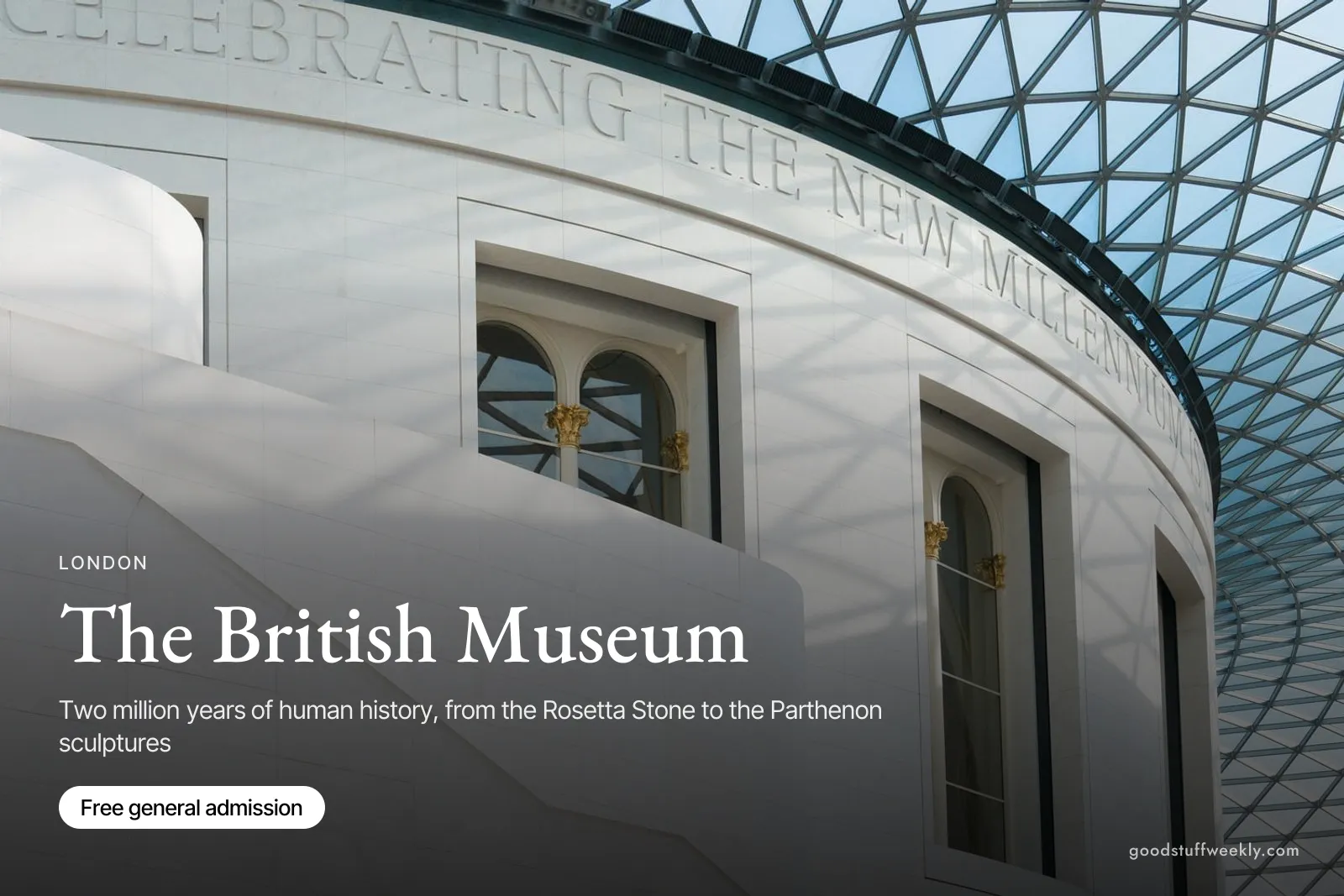
The British Museum: Two Million Years of Human Making Under One Roof
Few museums attempt something as sprawling as the British Museum. Its galleries hold objects made by people on every continent across roughly two million years, from stone hand-axes flaked in East Africa to woodblock prints from modern Japan. Some visitors come with a single target, the Rosetta Stone, and leave with a much wider appetite for ancient Egypt, Mesopotamia, Greece or medieval Europe.
The museum counts around 8 million objects in its holdings, but displays well under one per cent of them, approximately 50,000 items spread across nearly 100 galleries. In 2025 it welcomed 6.4 million visitors, making it the second most visited attraction in the United Kingdom, and general admission is free.
About the Museum
The museum begins with a doctor's collection. Sir Hans Sloane, a physician and naturalist, left around 71,000 objects, along with tens of thousands of books and manuscripts, to the nation when he died in 1753 on the condition that Parliament pay his heirs £20,000. George II gave royal assent to the Act founding the British Museum on 7 June 1753, and the institution opened in 1759 in a seventeenth-century mansion, Montagu House, on the same site.
As collections grew through donations and acquisitions, Montagu House proved too small. Sir Robert Smirke designed the present Greek Revival building, begun in 1823, with a colonnade of towering Ionic columns that gives Great Russell Street its grand front. The Round Reading Room, designed by Sydney Smirke and completed in 1857, once counted Karl Marx and other famous scholars among its readers; it stayed in use until the British Library moved out in the late 1990s.
In December 2000, architect Foster + Partners reworked the museum's central courtyard into the Queen Elizabeth II Great Court, covered by a curving lattice of glass and steel. It is the largest covered public square in Europe, and it made the entire ground floor navigable in a way that the old building never was.
The Collection
The British Museum holds around 8 million objects, of which fewer than 1 per cent, roughly 50,000 items in nearly 100 galleries, are on display at any time. The holdings run from Oldowan stone tools to contemporary prints and posters, and they are organised into curatorial departments that include Egypt and Sudan, Greece and Rome, the Middle East, Asia, Africa, Oceania, the Americas, Britain and Europe, and Coins and Medals.
The founding gift of Sir Hans Sloane, about 71,000 objects plus books and manuscripts, still forms part of the core, but the majority of the collection arrived later through excavations, purchases, donations and bequests. Its size makes it one of the best places on earth to compare how different societies handled the same human needs: writing, worship, trade, adornment and burial.
What Can You Explore?
With this much on display, some orientation helps. These are the rooms visitors most often plan around.
- The Rosetta Stone (Room 4). A granodiorite slab carved in 196 BC with a decree in three scripts, found in 1799 and taken to Britain in 1802. It provided the key that Jean-François Champollion used to decipher Egyptian hieroglyphs. Cases in front are often crowded by late morning.
- Egyptian Sculpture Gallery and mummies. Colossal statues, painted coffins and the Book of the Dead papyri are spread over several rooms, including an upper-floor gallery of mummies and funerary equipment.
- Parthenon sculptures (Room 18). Marble figures and reliefs from the Athenian Acropolis, removed in the early nineteenth century. Their ownership is the subject of a long-running public debate between British and Greek authorities, and the museum presents them with context about that discussion.
- Assyrian reliefs. Alabaster panels from the palaces at Nineveh and Nimrud, including the detailed royal lion hunts, are among the finest works of ancient narrative art.
- Sutton Hoo and Mildenhall. The famous seventh-century Anglo-Saxon helmet and treasures from an East Anglian ship burial, along with Roman silver, tell much of early British history.
- Lewis Chessmen. Walrus-ivory chess pieces from twelfth-century Scandinavia, discovered on the Isle of Lewis in 1831. Their wry, worried faces have become a favourite of children and adults alike.
- Hoa Hakananai'a. A basalt moai, or statue, from Easter Island in the Pacific, that stands among the museum's Oceanic and world-cultures displays.
- Africa, Americas and Asia. Benin bronzes, Mesoamerican mosaics, Chinese ceramics and Indian sculpture appear across the building, and ongoing discussions about provenance and return shape how some of these are presented.
- Enlightenment Gallery (Room 1). The original King's Library, restored to display objects the way eighteenth-century collectors thought about them.
Museum Architecture & History
Approach from Great Russell Street and you will first see the Ionic colonnade, with sculpted figures in the pediment by Sir Richard Westmacott depicting the progress of civilisation. Inside, the Great Court is the building's natural crossroads. Its white lattice roof, made of thousands of individual glass panels, floods the circular Reading Room at its centre with daylight.
The Reading Room is open to visitors when it is not in use for events, and it is a good place to sit for a few minutes. A spiral staircase and gallery around it give views of the shelves and the domed ceiling that nineteenth-century readers worked beneath.
Online Collections & Research
The museum's online database lets you search and view hundreds of thousands of objects, with photographs, dimensions, materials and provenance where known. Online galleries tell stories through themes rather than gallery numbers, which is a good way to prepare a visit. For researchers, the Study Room and Prints and Drawings Study Room offer access to objects that are not on display, by appointment.
Visitor Experience
Plan the day by region or time period, not by trying to see everything. Two or three hours suits a focused visit to Egypt, Greece and Rome; a full day only covers a fraction of the museum.
- Arrive at opening. The Rosetta Stone and the Parthenon rooms fill up quickly after 11:30, when tour groups arrive.
- Try Friday evening. Late opening brings a quieter atmosphere, and the Great Court feels calmer once daytime crowds have gone.
- Use side entrances. The Montague Place entrance at the back often has shorter queues than the main gate.
- Look at the small things. The most memorable objects are sometimes modest: a child's toy, a tiny amulet, a coin from a shipwreck.
- Eat with a view. The Great Court has a café and a restaurant, and there are several pubs and cafés in Bloomsbury within a few minutes' walk.
Planning Your Time
A three-hour plan for the British Museum works best if you resist the urge to see everything. Enter early, go straight to the Rosetta Stone in Room 4, and continue through the Egyptian sculpture gallery to the mummies upstairs. Return to the Great Court, walk east to the Assyrian reliefs, then cross to Room 18 for the Parthenon sculptures. If time allows, finish with the Sutton Hoo helmet and the Lewis Chessmen in the medieval rooms, and end with a coffee under the glass roof.
Friday evenings, when the museum stays open until 8:30 pm, are the quietest time for the Egyptian and Greek rooms. Midday on Saturdays and during school holidays is the busiest, especially around the Rosetta Stone. In winter the Great Court is a warm place to rest, and in summer the front steps make a good spot to take stock. A second visit focused on Asia, Africa or the Americas rewards those who liked the first.
Visit
The museum is open every day from 10:00 am to 5:00 pm, and on Fridays it stays open until 8:30 pm. Some galleries close earlier than the main building, and hours can change on bank holidays, so check the website before you travel.
Tickets
General admission is free, and a timed entry ticket can be booked online to speed up entry and avoid queues at peak periods. A donation of about £5 is suggested but not required. Special exhibitions are ticketed separately, with adult prices often around £18, and audio guides and guided tours can be booked on-site or online.
Getting There
The museum is in the middle of Bloomsbury, close to several transport hubs:
- Tottenham Court Road (Central and Northern lines, Elizabeth line): about a 7-minute walk.
- Holborn (Central and Piccadilly lines): about 7 minutes on foot.
- Russell Square (Piccadilly line): around 8 minutes.
- Goodge Street (Northern line) and Euston Square are also within walking distance.
Several bus routes pass along New Oxford Street and Tottenham Court Road, and the museum is only a short walk from Covent Garden and the West End.
Accessibility & Visitor Services
The Great Russell Street entrance has steps, so wheelchair users and parents with strollers are directed to the step-free Montague Place entrance at the rear, where lifts reach most floors. Some upper galleries in the Egyptian and Roman wings are reached by long staircases, but alternative lift routes exist, and staff will show them. There are quiet spaces, large-print guides and sensory information for visitors who need a calmer route through the Great Court's crowds.
Who Is It For?
- Students and teachers who want to see the objects their textbooks describe.
- History and archaeology enthusiasts who like to compare cultures from different regions and eras.
- Families, with trails, activity packs and galleries like the Egyptian mummies that hold children's interest.
- Designers and craftspeople, who will find ceramics, metalwork, textiles, jewellery and glass from every era.
Things to Know
- Book a timed entry: Entry is free, yet a timed slot shortens the security queue considerably, especially at weekends.
- Rooms close in stages: Some galleries shut earlier than the main building, so head for your priorities first.
- Objects are on loan: Big names travel, so confirm a specific piece is on show before you plan a route around it.
- Read the debate: Labels on the Parthenon sculptures and Benin bronzes acknowledge ongoing questions about ownership and return.
- Use side doors: The Montague Place entrance is quieter than the front gate, especially during morning peaks.
- Eat around the corner: The Great Court cafés fill quickly, and Bloomsbury has cheaper options a few minutes away.
Explore the British Museum
The British Museum can be a two-hour highlights walk or a return-visit habit. Choose a region, book a timed slot if you want to skip the queue, and give yourself time to sit in the Great Court and absorb what you have seen.
Visit the British Museum
For current opening hours, tickets, accessibility services and exhibitions, visit the official British Museum website before you travel.
Looking for more? Browse all museums on Good Stuff Weekly.
Last updated