Victoria and Albert Museum
The Victoria and Albert Museum in London is the world’s leading museum of art and design, with fashion, ceramics, the Raphael Cartoons and the Cast Courts. Entry is free.
The World's Greatest Museum of Art and Design, Free to Walk Into
If you want to understand how people have made things beautiful, useful and strange over five thousand years, the V&A is a good place to lose a whole day. Its galleries sit in a Victorian palace of terracotta and brick in South Kensington and hold roughly 2.8 million objects, across 145 galleries: dresses, teapots, altarpieces, posters, stage costumes, carpets, jewellery, photographs, furniture and full-size plaster copies of some of the most famous sculptures in Europe.
Admission to the permanent collection is free, so you can come for an hour to see a single room and come back another day for another. Over 3.3 million people visit each year, and they arrive with very different agendas: fashion students sketching hems, families hunting for the giant plaster David, researchers requesting a print from the study room.
About the Museum
The V&A began with an argument about taste. After the Great Exhibition of 1851 in Hyde Park, its organisers, including Prince Albert and civil servant Henry Cole, wanted to put good design in front of manufacturers and the public. The Museum of Manufactures opened in 1852, initially in Marlborough House, and moved to South Kensington in 1857 as the South Kensington Museum, opened by Queen Victoria. The idea was educational: examples of excellent craftsmanship would raise standards in industry and schools.
The collection grew fast through purchases, gifts and exchanges, and by the end of the century it needed a grander home. In 1899, Queen Victoria laid the foundation stone of a new building by Aston Webb, and at that moment the museum was renamed the Victoria and Albert Museum in honour of her late husband. The façade on Cromwell Road, completed in 1909, is the one visitors see today.
The twenty-first century brought more expansion. The V&A now operates additional sites: Young V&A in Bethnal Green, V&A Dundee in Scotland (opened in 2018), V&A East Storehouse in Queen Elizabeth Olympic Park (opened in 2025), and the V&A Wedgwood Collection in Stoke-on-Trent.
The Collection
The V&A's holdings are among the largest and most varied in the world. They include one of the most important collections of Asian art outside Asia, with more than 160,000 pieces, and one of the world's largest groups of Islamic art, with more than 19,000 objects. British and European art from the Middle Ages to the present, sculpture, ceramics, glass, metalwork, textiles, fashion, jewellery, photography, theatre and performance material, and architectural fragments also fill the museum.
Around 62,000 objects are on public display at the South Kensington site, but many more can be viewed by appointment in study rooms, and V&A East Storehouse gives open-access views of parts of the reserve collection.
What Can You Explore?
A few of the sections that visitors ask for most often:
- Fashion. A chronological display from the seventeenth century to the present, with couture dresses, tailoring, embroidered waistcoats and streetwear. The V&A's fashion collection is one of the most important in the world.
- The Cast Courts. Two immense galleries of nineteenth-century plaster casts of monuments including Trajan's Column, cut in half to fit, and a full-scale replica of Michelangelo's David, complete with a removable plaster fig leaf that the museum once kept for royal visits.
- The Raphael Cartoons. Seven huge designs for tapestries for the Sistine Chapel, painted by Raphael in the early sixteenth century and on loan from the Royal Collection.
- Ardabil Carpet. One of the oldest and finest Islamic carpets in existence, made in Persia in the sixteenth century.
- Tipu's Tiger. A life-size wooden automaton of a tiger attacking a soldier, made for the ruler of Mysore in the late eighteenth century.
- Jewellery. A dazzling gallery that moves from ancient Greek gold to contemporary studio pieces.
- Ceramics. One of the largest ceramics collections in the world, spread over several floors, with works from Iznik to Meissen.
- Theatre and performance. Costume, set design and stage models, including material from rock concerts and musicals.
- Photography and prints. Early photographers, poster art and illustration are shown in rotating displays.
Museum Architecture & History
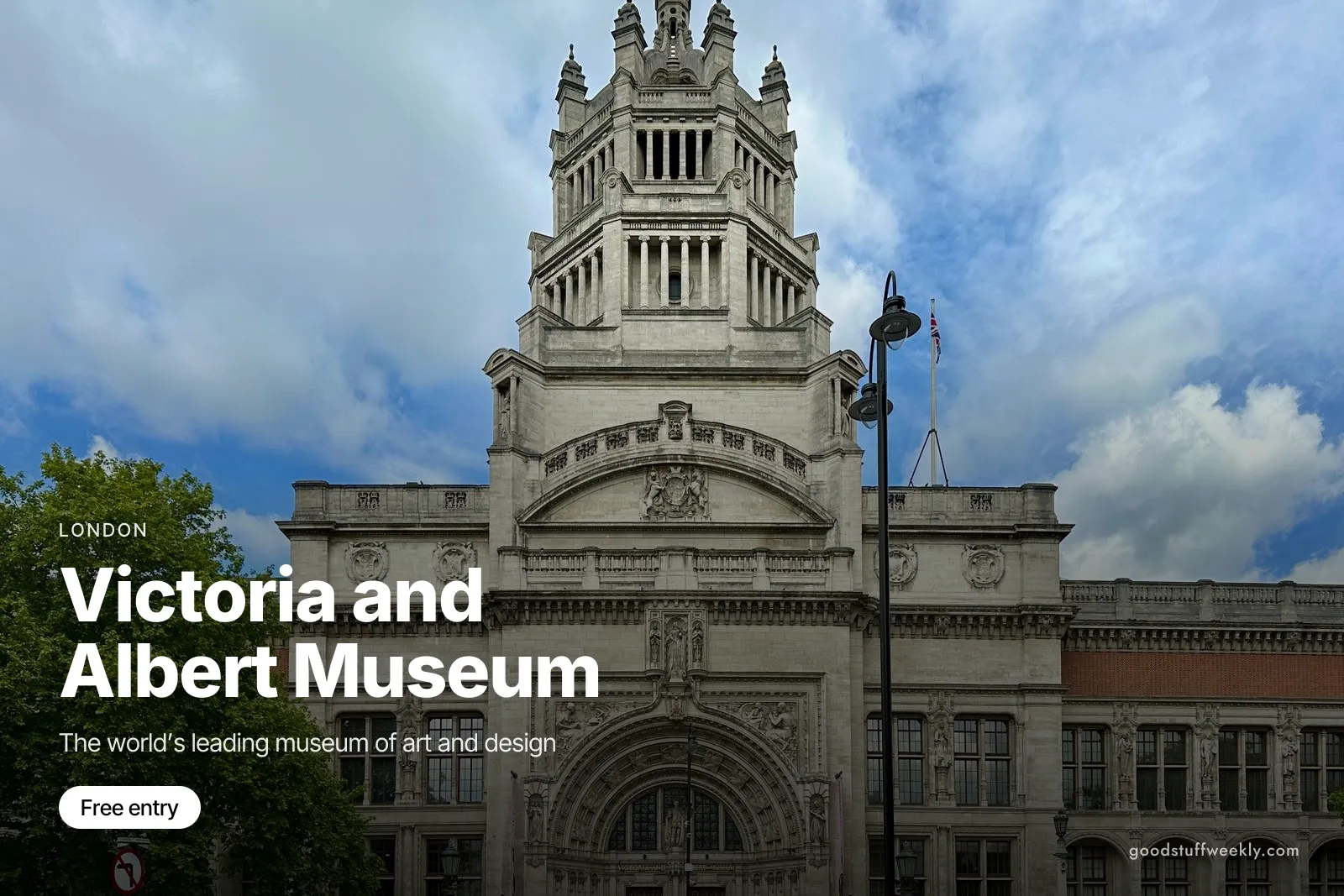
The building is an assembly of styles. Aston Webb's grand entrance on Cromwell Road, capped with a crown-shaped lantern, reflects Edwardian confidence, while the older parts behind it, designed by Captain Francis Fowke and others, exhibit the Victorian love of decorated brick and terracotta. Courtyards, staircases and small galleries link them together in a somewhat maze-like plan that many visitors enjoy getting lost in.
In the centre, the John Madejski Garden is a tranquil courtyard with a shallow pool and lawn, a favourite lunch spot in summer. The Dale Chihuly glass chandelier in the entrance rotunda is a bright contemporary contrast to the Victorian interior. The Exhibition Road entrance, opened in 2017 with a large underground gallery, added space for temporary exhibitions.
Online Collections & Research
The V&A's online collection database, called Explore the Collections, contains images and detailed information on hundreds of thousands of objects. Its website also carries essays, videos and design-history articles. The National Art Library, one of the largest specialist art libraries in Britain, is open to readers, and study rooms let researchers view textiles, prints, furniture and photographs by appointment.
Visitor Experience
The museum's size can be intimidating, but its layout invites browsing. A quick highlights route takes two to three hours, and a full day allows time for a special exhibition and a meal.
- Choose a theme. Fashion, Asia, sculpture or ceramics each make a coherent visit on their own.
- Try a Friday Late. On the last Friday of the month, the museum opens until 10 pm with music, talks and pop-up events.
- Rest in the garden. The courtyard in summer, or the cafés in winter, give a break from the galleries.
- Look up. Ceilings, stairwells and stained glass are often as interesting as the objects.
- Take the tunnel. A pedestrian subway links South Kensington Underground station to the museum, saving you from crossing busy roads.
Planning Your Time
The V&A is huge and unusual in that nothing is organised chronologically from the front door, so a small plan helps. Start in the Medieval and Renaissance galleries and the Raphael Cartoons, then cross to the Cast Courts, which usually delights first-time visitors. Upstairs, spend an hour in Fashion, Jewellery and the Ceramics galleries, and finish in the John Madejski Garden in good weather, where the pool and the arcades make a quiet pause. If you have time, add the Asian collections, the theatre and performance galleries, and the Exhibition Road entrance building for contemporary displays.
Friday evenings, with the museum open until 10:00 pm, are the best moment for the Fashion galleries and a drink in the courtyard. Weekend afternoons and school holidays are the crowded periods, especially around the entrance rotunda. Half a day covers a personal selection, and a second visit rewards you if you love design.
Visit
The museum is open daily from 10:00 am to 5:45 pm, with late opening on Fridays until 10:00 pm. Some galleries may close early or be temporarily closed for renovation, so check the museum's website before you go. Opening hours can also change on public holidays.
Tickets
General admission is free, and you do not need to book in advance. Some special exhibitions charge an entry fee, typically in the range of £17 to £30, depending on the show and the day of the week. Members and certain ticket holders receive free or discounted access to exhibitions. Book ahead for popular shows, since timed slots can sell out.
Getting There
The museum is in South Kensington, next to the Natural History Museum and the Science Museum.
- Underground: South Kensington station (Piccadilly, District and Circle lines) is about five minutes away through a subway.
- Bus: Several routes stop on Cromwell Road and Brompton Road.
- On foot: From Hyde Park or Knightsbridge, walk south past Harrods and the Brompton Oratory.
- Cycling: Docking stations for bicycles are near the entrances.
Accessibility & Visitor Services
The V&A is one of the more welcoming large museums in London. Both main entrances are step-free, lifts reach the upper galleries, and accessible toilets are on every main floor. Because the building is a maze of old wings, ask at the desk for a printed map that marks the step-free route. Sensory and quiet-hour programmes run on selected days, and BSL and captioned tours are advertised on the website. The gardens are also step-free and have seating.
Who Is It For?
- Fashion, textile and jewellery students, who can study construction and materials up close.
- Illustrators, graphic designers and photographers, thanks to posters, prints and photographic collections.
- Architects and interior designers, who will find fragments, models and period rooms.
- Craftspeople and makers, drawn to the ceramics, metalwork, glass and furniture.
- Families, with trails and activities, and the nearby Young V&A.
Things to Know
- Free, but exhibitions are ticketed: Blockbuster fashion and design shows sell out weeks ahead, so reserve early.
- Friday late openings: The museum stays open until 10:00 pm on Fridays, with events and a bar on some evenings.
- Two front doors: The Cromwell Road entrance is grand, while the Exhibition Road entrance is quieter and step-free.
- Some galleries close for works: Rooms are refurbished in rotation, so check whether a specific gallery is open.
- Cast Courts photography: Photography is generally allowed in the courts, but bags and tripods may not be.
- The Museum of Childhood: The Young V&A in East London is a separate site and has its own times and entry rules.
Explore the Victoria and Albert Museum
Design is at its most fascinating when you see it in the object itself, and few places in the world have as many objects as the V&A. Choose a corner of the museum, let yourself wander, and check the website for exhibitions, Friday Lates and opening hours.
Visit the Victoria and Albert Museum
For current opening hours, tickets, accessibility services and exhibitions, visit the official Victoria and Albert Museum website before you travel.
Looking for more? Browse all museums on Good Stuff Weekly.
Last updated